Monday, 19 December 2011

RIP The Producer from Hell

Woolly Valley's Deathwatch 2012 continues!

"The task set before the cinema today is one of contributing to people's development into true communists ... This historic task requires, above all, a revolutionary transformation of the practice of directing."

Kim Jong Il's On the Art of the Cinema (1973)

Kim Jong-Il - leader of the world's only hereditary Communist state, North Korea - has died. Sure, he was a dictator who ruthlessly suppressed his people, left millions to starve and lead his country into isolation from the rest of the world, but we here at Woolly Valley prefer to remember him as a fellow film fan. We remember him as a fellow film fan who had the guts to try and make a "socialist Godzilla" by kidnapping and imprisoning director Shin Sang-ok and forcing him to eat grass. We remember him as a man who dug on Elizabeth Taylor. We remember that he inspired the funniest bits of Team America, World Police.

And we remember him as one scary mother fucker.

Friday, 16 December 2011

RIP Bert Schneider

Bert Schneider collecting the 1975 Oscar for Best Documentary (Hearts and Minds)
Political activist and film producer Bert Schneider has died at the age of 78. Schneider was the muscle behind Easy Rider, Five Easy Pieces and The Monkees.

Bert Schneider, 5 May 1933 - 12 December 2011

Monday, 12 December 2011

Charles Mingus’s 5-Star Rapturous Deadly Holiday Eggnog

"1.  Separate one egg for one person. Each person gets an egg.

2. Two sugars for each egg, each person.

3. One shot of rum, one shot of brandy per person.

4. Put all the yolks into one big pan, with some milk.

5. That’s where the 151 proof rum goes. Put it in gradually or it’ll burn the eggs.

6. OK. The whites are separate and the cream is separate.

7. In another pot— depending on how many people— put in one shot of each, rum and brandy. (This is after you whip your whites and your cream.)

8. Pour it over the top of the milk and yolks.

9. One teaspoon of sugar. Brandy and rum.

10. Actually you mix it all together.

11. Yes, a lot of nutmeg. Fresh nutmeg. And stir it up.

12. You don’t need ice cream unless you’ve got people coming and you need to keep it cold. Vanilla ice cream. You can use eggnog. I use vanilla ice cream.

13. Right, taste for flavor. Bourbon? I use Jamaica Rum in there. Jamaican Rums. Or I’ll put rye in it. Scotch. It depends. See, it depends on how drunk I get while I’m tasting it."

via skies of blue

Tuesday, 6 December 2011

RIP Cynthia Myers

Cynthia Myers, best known as Casey Anderson in Russ Meyer's Beyond the Valley of the Dolls, has died at the age of 61.


Friday, 25 November 2011

Will Young: Jealousy

Not usually my cup of musical tea, but it's damn catchy and the video is based on the 1956 Burt Lancaster vehicle Trapeze. Solid.

Friday, 11 November 2011

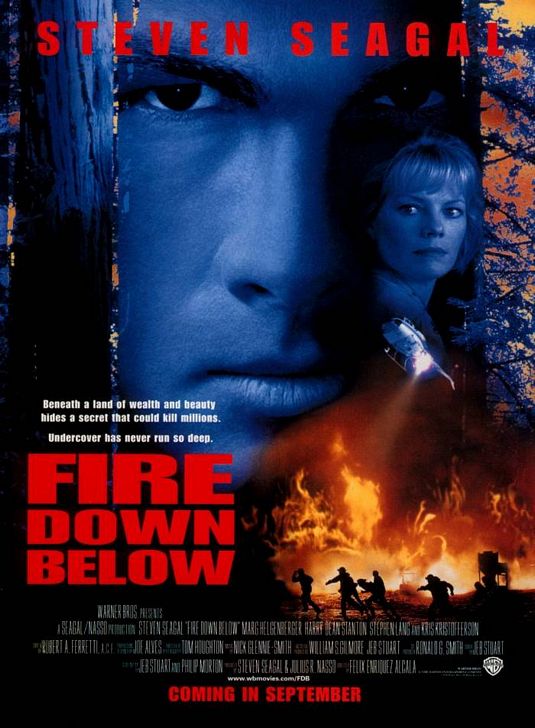
Fire Down Below (1997)


Let’s get the obvious out of the way first: despite the title, Fire Down Below (1997) is not about sexually transmitted infections, although if Steven Seagal’s parents had not had sex it’s arguable that the world of straight-to-DVD releases would be much poorer.

Fire Down Below was made during Mr Seagal’s eco-warrior phase. Please, stop laughing: never before has Mother Nature had her honour defended with so much ass kicking and bluegrass music. Set in the Appalachian mountains, it begins with Mr Seagal using green screen technology to pilot a small plane through a breathtakingly beautiful wilderness. In sepia-toned flashbacks, we’re told that his character is an environmental protection agent and on his way to avenge – oh, I’m sorry, investigate – the mysterious murder of his friend in a small mining town where evil Kris Kristofferson’s evil company is disposing of toxic waste in the disused mine shafts. And really, what more environmentally friendly way to travel is there than by private plane?

On the soundtrack, some dude bellows over a steel guitar about a “copperhead sittin’ on a sycamore log”. If you don’t like country music and its associated genres, then Fire Down Below is going to go out of its way to alienate you. This is a film that cannot get to grips with the idea that not every scene requires some form of hootenanny on the soundtrack.

Aided by the town’s kindly preacher, Mr Seagal’s flimsy cover story is that he’s in town to help the locals rebuild their collapsing shacks, and, as a bonus, blow them all away with his awesome guitar chops. A sheriff in the pocket of the corporation warns Mr Seagal that he’s seen his kind before: “Drunks. Bums. Ex-cons. All tryin’ to atone for somethin’.” Or, as Mr Seagal serenely puts it, “I’m just here doing God’s work.” And you know what? The bastard probably believes it.

A couple of points here.
Firstly, no, I didn’t bother learning the name of Mr Seagal’s character. There was no point because Steven Seagal’s character is always Steven Seagal. This is why Steven Seagal is not a bad actor: to be a bad actor, first you need to try to act. You are not an actor if, in all of your roles, you have the same haircut, the same outfits (in fairness, at one point in this film Mr Seagal does sport a spectacularly ugly jacket with a bright, Aztec-style print) and the same narrow-eyed delivery of terrible/great dialogue, including this unintentionally flirtatious exchange:

Kristofferson: You’re violating my constitutional rights.
Seagal: I’ll show you a new meaning to the word ‘violation’.

Secondly, for a film in which Mr Seagal spends a great deal of time speechifyin’ about how the evil mining company is treatin’ the good people of this community like dumb hillbilly hicks, it spends a great deal of time depicting the people of the Appalachian mountains as dumb hillbilly hicks.


The notable exception to this rule is Mr Seagal’s putative love interest, Sarah (a pre-botox Marg Helgenberger). Sarah keeps bees and sells honey, which doesn’t bring her in much money on account of her having murdered her daddy when she was 16 and the townsfolk never having forgiven her for it. Within five minutes of meeting her Mr Seagal works out what the dumb hillbilly hicks haven’t been able to in nearly 20 years: Sarah’s brother killed their father when the old man worked out that Sarah’s brother had been molesting her. To make the point even clearer and more repellent, Sarah’s brother calls her a whore and promises her that after he’s killed Mr Seagal, “Things will go back to the way they were when daddy was alive.” Because, you know, that’s how men who live outside cities and don’t have a lot of money behave towards their sisters.

Faster than you can say “the perpetuation of grossly offensive stereotypes of the rural poor”, toothless thugs clad in dungarees and checked shirts are hiding venomous snakes in Mr Seagal’s bedroom, attempting to violently assault him in pool halls, and showing him the kind of cheerful small-town hospitality that consists of greeting strangers with “Fuck are you doin’ here, pretty boy?” The funniest thing about this is that even by the scrofulent standards of the locals, Mr Seagal is still not “pretty”.

A “hilarious” exchange in which Mr Seagal compares his would-be assailants to the supporting cast of Deliverance before beating them senseless only serves to remind viewers that they could be watching a much better film. At various other points, Mr Seagal threatens to shoot dead a sheriff’s deputy and hands a gun to a young boy with instructions on how to use it. Anywhere else in the world such behaviour would be considered sociopathic: in Fire Down Below this is the way the good guy gets shit done.

After a pretty decent pick-up vs Mac truck chase scene, set to Hendrix’s Little Wing for some reason, Mr Seagal storms back into town with a new and artfully placed cut on his cheekbone. He interrupts the preacher mid-sermon to literally preach to the townsfolk about their responsibilities to the environment and future generations. Presumably to prevent such a horrific instance of pulpit abuse from ever happening again, the church is later burned to the ground in scenes that will gladden the heart of any Norwegian black metal fan.

The film closes with the legendary Harry Dean Stanton wearing denim overalls, sitting on his new, Seagal-built porch and playing the guitar and singing. He’s pretty good, too. But this brief vignette is in no way a big enough dollop of ointment to soothe the itchy, irritating and lingering effects that come from wasting a couple of hours of your life on Fire Down Below.

Originally published by Filmwerk

Friday, 4 November 2011

Siren (2010)

At the heart of Siren is a great idea that could revitalise the horror genre (stay with me). Zombies are so hot right now, but they are not sexy (unless, of course, you are a very specific kind of necrophiliac, in which case ... ew). Vampires are totally sexy, but they are a bit 2009 and plus, there’s the whole Twilight-wussification thing. The ghouls populating the likes of Paranormal Activity and The Blair Witch Project have no screen presence – who knows if they’re sexy or not? The film world is crying out for the next big thing in hot supernatural beings who want to kill us.
Perhaps Siren provides the answer, if nothing else. Mermaids, after all, are probably where we get the term ‘dead sexy’. As far as horror goes, they are also an untapped resource. The Little Mermaid has a lot to answer for: the mermaids of Greek myth were dreadful old-school style. They hung out on rocks in all weathers, crooning to lonely passing sailors only to lure them to their deaths. Their only purpose was to look gorgeous from the waist up and ensure that men died horrible deaths that involved their bodies being bashed to smithereens on razor-sharp rocks and their lungs filled with sea water. But as we know, mermaids have bare bosoms and they don’t have any lady-bits Down There: female sexuality is so scary that even the fictional embodiments of it aren’t allowed hoo-hahs.
Sadly, Siren is also lacking in crucial areas. The film opens promisingly enough, with lovely brunette Lindsay Lohan-lookalike Anna Skellern nearly causing her beefcake boyfriend to crash their car just because she’s so damn attractive. (Yes, this is a portent of things to come.) Beefcake and Brunette then pick up Brunette’s ex-boyfriend, World Travelling Guy. We can tell he is more sensitive than Beefcake because unlike Beefcake he doesn’t earn tons of money and he wears pendants on leather thongs around his neck.
The three of them go on a sailing holiday (top tip: don’t travel on a boat named for Persephone, Queen of the Underworld) that capsizes when they rescue an emaciated dude from a deserted island only moments before he starts bleeding from the ears and drops dead. Going ashore to bury him (on the flimsiest pretext imaginable), the trio meet Silka (Tereza Srbova). Given the title, it’s not a spoiler to tell you that she is The Most Uncharismatic Mermaid Ever™.
Srbova is more dead fish than alluring femme fatale, and she helps to sink Siren faster than you can say “But the whole film stinks.” As soon as the credits rolled I had trouble remembering what she looked like, beyond “pretty, blonde.” Even her allegedly mesmerising song of doom is an instantly forgettable bit of pop-lite fluff. And why does it take her so long to get around to singing it? Why does she want to keep the guys around when it’s plainly Brunette she’s interested in doing a bit of synchronised swimming with?
For a film aiming for psychological terror over gross-out gore, it would help if there were at least one character whose fate you could care about. Unfortunately, Beefcake is a total buttmunch – his last-minute conversion to caring partner is wholly unconvincing – and World Travelling Guy is only there to help increase the (very small) number of things on screen that can run and bleed. Since the box cover compares Siren to The Hunger, there’s never any reason to worry about Brunette.
Is there anything to like about Siren beyond its premise? Well, for what it’s worth, in spite of her thankless role as Hot Chick in Peril and accordingly lousy dialogue, I thought Anna Skellern had great screen presence. But you’d still be well advised to just throw Siren back into the murky depths from whence it came.
Originally published by Filmwerk

Tuesday, 1 November 2011

The Woman (2011)

The Woman is a low-budget horror from director Lucky McGee and co-writer Jack Ketchum that – despite the hype generated by one audience member’s (scripted?) walk-out at its Sundance screening – relies more on psychology than gross-out to get its reactions. Unfortunately, despite strong performances from a talented cast (especially Pollyanna McIntosh in the title role and Sean Bridgers as the deranged dude trying to ‘act’ normal), this approach takes the film only so far.
A sort-of sequel to Ketchum’s Offspring, which was about a clan of Maine cannibals, The Woman never references its own back story – so it can be viewed as a stand-alone film (and probably ought to be, given the excoriating reviews garnered by the film version of Offspring). A hunter encounters The Woman in the woods, where she appears to be living like an animal. He spends a good long while perving at her through his rifle sights, and then returns later on to drag her off to imprisonment in a cellar. Doting family man and respected member of the community Chris Cleek cheerfully announces to his wife and stunned brood that The Woman is their ‘new project’.
Alas, Chris’ sunny demeanour masks a demented psycho, and he and his abused wife and their disturbed children are not up to the task of ‘civilizing’ The Woman. The longer she remains tethered in their cellar, the weaker the family’s already feeble grip on normality becomes.
However unpleasant the premise, The Woman is not, much to this reviewer’s untold relief, torture porn. Terrible things happen, both to The Woman and because of her, but it is not until the rather rushed denouement that the viscera start to fly. But nor is this a fresh, intelligent treatment of the war of the sexes in the vein of the thematically similar Black Snake Moan. In fact, The Woman feels downright old-fashioned – like something rescued from the video nasties era and given a polish. It’s not as smart as it obviously thinks it is.
Gender politics have (for most of us) moved on from the tired old “women = nature/all men are rapists” lines, and the exposé of the rotten teeth behind suburbia’s tight smiles has almost become a cliché. This is a shame, because The Woman needed to offer something original to rise above being a solid, yet disposable, cheapie B-movie.
Originally published by Filmwerk

Wednesday, 26 October 2011

Journey to Promethea


Billy Zane - now making movies with production budgets that allow extras to be paid in glasses of Red Bull and vodka.

Friday, 21 October 2011

Cape Fear (1991)

When Gus Van Sant released his near shot-for-shot remake of Psycho, it was to a bemused response of “Why?” It added nothing to the original, apart from an unintentionally funny vignette in which Vince Vaughn masturbated – legendary film critic Roger Ebert thought this appropriate because the “new Psycho evokes the real thing in an attempt to re-create remembered passion.” The only good thing Ebert had to say about the Psycho 1998 vintage related to its role as a curio:

“The movie is an invaluable experiment in the theory of cinema, because it demonstrates that a shot-by-shot remake is pointless; genius apparently resides between or beneath the shots, or in chemistry that cannot be timed or counted.”

Whatever its faults, Scorsese’s 1991 remake of the 1962 classic thriller Cape Fear is not simply a shot-by-shot homage. Some basic elements remain – the key plot details, the central characters and the main locations, for example – but other, more radical changes make this a quite different tale from J Lee Thompson’s. Even the opening titles signal Scorsese’s intention to make this his own, for better or worse, despite the employment of Saul Bass. Let’s compare and contrast, shall we?


The most obvious and dramatic change is to the characters of the Bowden family, and Sam Bowden in particular. In the 1962 version, the Bowdens are so sweet that they’re a diabetes risk factor. The Bowdens’ daughter Nancy is preternaturally beautiful (Lori Martin was later cast as Velvet Brown in the television version of National Velvet partly on the basis of her resemblance to Elizabeth Taylor), and there is no evidence that her sunny demeanour masks anything other than a fastidiousness about her appearance. Peggy and Sam have a model marriage, Sam is a pillar of the community and their house is freakin’ awesome.

Flash forward 30 years, and the Bowdens are unrecognisable. The house is still freakin’ awesome, but Peggy and Nancy have become Leigh and Danielle, and while Jessica Lange is a good physical double for Polly Bergen’s original Mrs Bowden, they wouldn’t recognise each other. Peggy is a wife shaped by the pages of the 1950s Good Housekeeping, but Leigh is a chain-smoking, neurotic mess shaped by endless episodes of Dr Phil. And who could blame her? She can’t even design a stupid logo for a travel company, her husband’s been unfaithful to her, and her daughter is a hormonal, pot-smoking mess made worse by her parents’ constant arguing over Sam’s history of infidelity.

Meanwhile, Nancy has gone from doll-like perfection to Juliette Lewis. Everyone together now: “Holy shit! It’s Mallory Knox!” While Martin didn’t have a lot to do in the original beyond looking alternately adorable and terrified, she did it very well. (Thompson admitted that because she wasn’t his first choice for the role, that was Hayley Mills he gave her a hard time on set.) But Lewis’ performance in this movie is astonishing, and yet again proves that the Academy doesn’t know jack when it comes to handing out awards. Here’s the infamous ‘thumb sucking’ scene between her and De Niro (fairly NSFW):


In some ways this is, like a lot of things about Scorsese’s take, a bit over-ripe. Danielle’s white dress, the fairy tale stage set and De Niro’s “demonic Mesmerist” ensemble of red shirt and black suit all combine to provide some all-too obvious imagery. But who cares? The scene works – and mainly because of Lewis’ nuanced performance. The range of emotion she has to convey here (confused, flattered, embarrassed, horny, curious, scared) would drain a lesser soul, particularly up against a legend like De Niro. Watching her in this film is to be given all the more reason to hate her ill-fated yet stubbornly persistent music “career”.

The scene also brings to the fore the ‘oral fixation’ motif that Scorsese lays on with a trowel: as the pressure builds Sam joins his wife in her chain-smoking sessions, Cady is never without a cigar, Danielle wears a retainer and Leigh is busy applying lipstick the first time she catches sight of Cady, causing her to smear it off with her fingers in a leery close-up. Among the more unsavoury revelations about Cady is that he is suspected of a murder in which the victim’s tongue was bitten off, and he reproaches Bowden’s private eye for threatening him with the line “It’s not necessary to lay a foul tongue on me my friend.” Cady himself is a verbal powerhouse – the preposterous finale even sees him speaking in tongues.

Part of what Scorsese’s interpretation so interesting is his rejection of the simple “Good v Evil” plot of the original. In 1962, Gregory Peck’s Sam Bowden is a fine upstanding citizen whose testimony has helped to put Cady away for eight years. Thanks to the strict censorship in place at the time, the word ‘rape’ is never used, but we’re in no doubt as to what he witnessed Cady doing. However, his role in Cady’s incarceration is almost peripheral. Yes, he’s a lawyer, but he wasn’t Cady’s lawyer – his employment is merely symbolic of his character. Bowden is justice, and civilization, and common decency and all that is finest about humanity’s ability to organise itself into communities. Cady is precisely the opposite: he’s uncivilized, uncouth, and like an animal his actions are unpredictable and often violent. The exchange he has with poor, doomed Diane (Barrie Chase, more famous as Fred Astaire’s partner on the dance floor and in life) makes this explicit:

Diane: What would you know about scenery? Or beauty? Or any of the things that really make life worth living? You're just an animal: coarse, lustful, barbaric.
Max: Keep right on talkin', honey. I like it when you run me down like that.
Diane: Max Cady, what I like about you is... you're rock bottom. I wouldn't expect you to understand this, but it's a great comfort for a girl to know she could not possibly sink any lower.

When Cady does bother learning the rules, it’s only to twist them to his own ends. Nowhere is Max’s ability to subvert society’s order more vividly illustrated than in two key scenes. In the first, he employs a top-flight lawyer to enumerate the many instances of ‘police harassment’ that he has been subjected to (for reference skip to the 6.20 mark):

Show me the scene!

In the second, he attacks Diane – even though she has willingly gone with him to a hotel room. This is all part of the horror that is Max Cady: he can't get satisfaction unless he inflicts pain and suffering. Mitchum has to convey menace with simply a look and does it to devastating effect: De Niro, in a similar scene with Ileana Douglas, is unfortunately allowed to commit his horrors on camera. This is, in my view, a mistake. Part of what makes Cady’s attack on Diane so chillingly effective in the 1962 version is that we don’t know exactly what happens because it literally happens behind a closed door, and Diane is so traumatised that she refuses to speak about it. The audience is forced into accessing the darker reaches of its imagination. By 1991, however, we are spared nothing and Scorsese viscerally depicts Cady’s misogyny in a sickening sequence that does little to make Cady any more threatening than he would have been had the scene been omitted.

In the original film, Cady is a nightmare, and like a nightmare his existence can’t be explained or reasoned away. The revulsion that Peck’s Bowden feels in his presence is so strong he can barely articulate it – in a scene omitted from Scorsese’s version, Cady describes with blood-curdling calm what he did to his ex-wife when he got out of prison (or did he? A later phone conversation calls the veracity of the story into question). Bowden is appalled and, like Diane, equates Cady with something base and crawling – the serpent in the Garden. “You shocking degenerate. I've seen the worst – the dregs – but you... you are the lowest. Makes me sick to breathe the same air.”

There are echoes of this sentiment in the Scorsese film, but interestingly they tend to come from Cady himself. During the denouement, Cady screams at Bowden “Now you will learn about loss! Loss of freedom! Loss of humanity! Now you and I will truly be the same...” – the overt implication being that Cady is aware that he is perceived as something less than human, despite his quoting of Silesius: “I am like God and God like me. I am as large as God. He is as small as I. He cannot above me nor I beneath him be.”
In the 1962 version, Cady is picking on the Bowdens just because it suits him, and it’s his capacity for sexual violence that petrifies them even more than his evidently murderous rage. This leaves open the horrifying possibility that of all the people involved in getting him sent to prison – the detectives, the arresting officer, the lawyers, the judge – it was only the witness, Sam Bowden, who was blessed with a lovely wife and a beautiful, pubescent daughter. Not for nothing is the premise of Cape Fear still able to turn stomachs.

Scorsese doesn’t exactly do away with this possible interpretation, but he goes back to the original book (The Executioners by John D. Macdonald) for Cady’s motive for pursuing Bowden and his family. This time out, Sam was Cady’s lawyer, and furthermore he deliberately hid evidence that could have reduced the sentence because he was so horrified by Cady’s crime. This revision also reveals Bowden v2.0 to be deceitful when it suits him. Sam 2.0 also has a slightly different, though significant, reason for shying away from having Cady beaten by thugs. Whereas Nolte’s Bowden initially rejects the idea because “the law is my job!”, Peck’s Bowden is repulsed by the idea of resorting to brutality. This makes the actions of Nolte’s Sam more plausible, but less psychologically interesting to watch. Peck’s Bowden uses violence as an absolute last resort, when all ‘civilized’ avenues have failed him. In the final, climatic scene his belief in the supremacy of man-made justice prevails. As he holds a gun on the wounded Cady, Cady gestures for him to shoot. “Go ahead. I just don’t give a damn.”

But Bowden – though clearly tempted – has been misjudged. Whatever Cady has pushed him to, it’s not into becoming someone else. He’s able to see clearly what Cady would consider a fate worse than death. “No. No! That would be letting you off too easy, too fast. Your words – do you remember? Well I do. No, we're gonna take good care of you. We're gonna nurse you back to health. And you're strong, Cady. You're gonna live a long life... in a cage! That's where you belong and that's where you're going. And this time for life! Bang your head against the walls. Count the years – the months – the hours... until the day you rot!”

Letting Cady live is Bowden’s ultimate revenge, and it allows him to reassert himself as the civilized man and the moral core of the story. Obviously Scorsese found this ending too neat, too unchallenging – and the Sam Bowden character too lacking in moral shades of grey. In his version, no one is ever wholly ‘innocent’ – not Sam, not his wife and not Danielle. In the 1962 film, Cady’s beating by the three thugs is something that Sam orders reluctantly and would prefer not to know about. Scorsese has Bowden actually sneak down to scene of the ambush to watch Cady get his ‘hospital job’. Naturally, this has the added benefit of providing De Niro with yet another show-stopping monologue. Scorsese’s version is just over 20 minutes longer than the original, and although I didn’t time it I’m willing to bet that nearly all of that extra running time is devoted to De Niro set pieces.

The recasting of De Niro as a tattooed religious firebrand is an obvious nod to Mitchum’s other iconic villain role, serial killer Reverend Harry Powell in The Night of the Hunter. It is hard to escape the conclusion that the mash-up was done only to provide De Niro with more opportunities to chew the scenery and physically dominate every moment he’s on screen. Even when he doesn’t have any lines, De Niro is allowed to indulge the worst of his over-the-top tendencies:


Although I am among De Niro’s innumerable fans, Scorsese has not curbed his predilection for show boating – it’s an “everything plus the kitchen sink” performance, and having seen Mitchum’s more restrained, and therefore creepier, characterisation of Max Cady I have to say that I found De Niro’s version paled in comparison. I’m aware that many, many people would disagree, but Mitchum didn’t need a scene where he bites a woman’s cheek off to convey seething malevolence – he could do that just by being on screen:


Like Peck, Mitchum has a cameo in Scorsese’s Cape Fear. He plays the police lieutenant originally played by Martin Balsam (who himself pops up as a judge). When Cady has to submit to a strip search, Bowden gets an eyeful of his hellfire and brimstone body art for the first time. “I don’t know whether to look at him or read him,” murmurs Mitchum to Nolte. It’s a great moment, in part because it’s impossible not to hear it as Mitchum’s personal comment on De Niro’s interpretation of a character Mitchum had already made famous 30 years before – and it’s a pretty ambiguous assessment.

Peck also gets to play meta-references with his cameo as the defence lawyer hired by Cady. As he howls with moral outrage on behalf of De Niro’s bruised and bandaged Cady, he seems to be poking fun not only at his own turn as Bowden, but at his most famous role as Atticus Finch, the lawyer and paragon of decency in To Kill a Mockingbird.

But Scorsese’s playing with comparisons doesn’t end there: he’s not shy of drawing parallels between Cady and Sam in their respective relationships with Danielle, either. Upping the queasiness of this exchange between Sam and Danielle is the fact that it almost immediately follows her first scene with Cady – and it’s far more sexualised and violent. It takes place in her bedroom, she’s in her underwear (“Put some clothes on, you’re not a little kid,” Sam tells her with an uncomfortable awareness of their changing dynamic) and Sam is much, much rougher with Danielle when he puts his hand on her face than Cady was:


There is nothing comparable in the 1962 film to this scene, and it adds a whole new layer to the Bowden family dynamic. Nancy really was a little girl in need of protection – Danielle is on the cusp of becoming a woman, and Dad is not happy about it despite that fact that, during the overblown finale, Danielle’s diminishing childishness results in her being the first member of the family to strike at Cady, first with boiling water:


And then with lighter fluid:


This is in sharp contrast to wee Nancy back in ’62, who limply waves a fire poker at Cady before letting it drop as he approaches – a fire poker, incidentally, is exactly what the original flavour Cady claims his ex-wife tried to defend herself with when he tracked her down. In the days before Psychoanalysis was discredited, that was surely not a coincidence.

I have to admit that it took me some time to get over Scorsese’s technical and visual gimmicks – the saturated colours, the shots that faded into negatives, De Niro’s wardrobe. Although both films were made as decades drew to a close, Scorsese’s film is burdened by a hangover from the excessive 1980s, not the stylish and more austere 1950s. But all of that was forgivable until Scorsese decided to crank the ending up to 11:


This is in such stark contrast to the climax of the 1962 version, which was tauter than piano wire, that I don’t even know where to start. That bit where Danielle sets Cady on fire and he hurls himself off the boat but somehow manages to pull himself back on board despite the raging storm? As we’ve just seen, not nearly the end of it. Gone is the stealth with which Bowden had to creep through the reeds as Cady stalked him with a piece of lumber, gone is the eerie stillness of the night, gone is all the hold-your-breath, time-standing-still tension of the original. Now we have a storm, and a whirlpool, and a boat breaking up, and Robert De Niro proving harder to kill than a slasher-flick monster and speaking in tongues and Nick Nolte screaming “I’m going to kill you!”

I mean, Ishtar on a bike, it all goes so over the top that I haven’t even mentioned the ‘reveal’ that among the other skills Cady developed in prison was a gift for impersonation, which he uses to disguise himself as the Bowdens’ (Mexican, female) maid.

Ultimately, Scorsese puts ‘more’ into Cape Fear – more family dynamics, a ‘hero’ with more moral ambiguity, a villain with more of a love for the sound of his own voice – and as a result this is not as lean or as tense as the source material. It’s also unfortunate that he allows the whole thing to degenerate into laughable bombast in the final scenes.

This is a great movie in its own right, but it’s not a classic. That honour is still reserved for Thompson’s treatment.

Originally published by Filmwerk

Wednesday, 19 October 2011

The Jackal (1997)

Frederick Forsyth wrote a classic tale of international intrigue called Day of the Jackal. In 1973, it became a chilling classic film with the same name. In 1997, the film was remade as The Jackal: Forsyth was so outraged by the vandalism of his work that he had his name removed from the credits.

Here’s how I imagine this woeful, messy, ridiculous remake of Day of the Jackal came about.

SCENE:

A flashy restaurant somewhere in Hollywood (int, day). At a table are the The Jackal’s writers, Kenneth Ross and Chuck Pfarrer, and its stars, Bruce Willis and Richard Gere.

Bruce Willis: So, thanks for coming guys! It’s great to see you again, Bob, Don.

Kenneth Ross: Um, I’m Kenneth. And this is Chuck.

BW: Great! That’s just great. Listen, guys, Richard and I have been talking and we’ve come up with a way to make the script a lot better.

Richard Gere: Oh, yeah. A WHOLE LOT better.

Chuck Pfarrer: “Better”?

BW (leaning in confidingly): Listen, guys, we love your script. LOVE your script. Don’t we Richard?

RG (nodding vigorously): Oh, yeah. I love it so much it’s wrong. Like, I’ve had Cindy Crawford, but man oh man – your script is like…

BW: OK, Richard, OK. Listen guys, we adore all that stuff you’re doing with the Cold War setting  and having me be a rogue American double agent and Richard play an actual American and what not. But we don’t think it’s making the most of your biggest assets, am I right? Me and Richard! Like, listen guys, did you know that Richard is like the male Meryl Streep? I’m serious. Do your Irish accent for Jake and Angus, Richard.

RG: Shure an’ beggorah, oim Oirish!

BW: Woah. Woah. That is like … holy shit, man. Liam Neeson couldn’t do an Irish accent that good.

KR: Ah-hum…

BW: That is not a diss of Liam. What a beautiful man.

RG: Gorgeous.

BW: But suck ass at accents. So anyway, we’re thinking, right: let’s use these gifts. We’re actors; we should be acting. And this is a movie filled with terrorists and explosions and all that right-on stuff, but it strikes me that there is room for CHARACTERS in there. Characters who are, maybe, Irish. For example.

KR: OK.

RG: I’m a terrorist. Fine. But what if I’m an IRISH terrorist? There are loads of those in Ireland, right?

BW: Fuck yeah, there are.

CP: And you’re in an American prison because …?

RG: Shit, that’s your job! You put me in prison any way you want. You’re the writers, and I respect that as a fellow artist. I would NEVER, I swear to you, try to tell you how to create. But I figure I’ve met my beautiful Basque ex-girlfriend during some sort of international terrorist convention or some such …

BW: … where you both meet The Jackal … (Gere and Willis high-five.)

RG: You know it, baby! And The Jackal has betrayed us during an arms deal in Libya and shoots my girlfriend, and she was pregnant and lost our baby, and that’s why I’m so set on chasing him down. But she lives, and marries some other guy while I’m in prison on whatever thing it is that you two dream up, and then Sidney Poitier comes and gets me out of prison to help him chase down The Jackal. So that’s when I get to practically make out with her right in front of her husband and her kids, ‘cause y’know. I’m Richard Gere. She’s not over me, right?

BW: Bitch’d better not be! (Gere and Willis high-five again.)

KC: Basque? But Mathilda May is French. We’ve developed quite an elaborate though highly plausible backstory about Richard’s character having trained as a patisserie chef in Paris during his youth before joining the secret service to explain why he’s married to a French woman.

BW: Well, we called her, and it turns out that she’s always wanted to do her Basque accent. Between you and me, it’s not quite as good as Richard’s Irish accent, but … pfft. Chicks, right?

CP: Hm.

RG (through a mouthful of food): That thing about us being married is obviously not going to work now, so you might need to rewrite those scenes. And the ones that refer to me as a disgraced secret service agent. Oh, and Diane Venora would like you to make her a Russian army major instead of the First Lady’s American body guard.

KR: Let me guess: despite being from Connecticut, Diane has a great Russian accent she’s always wanted to use, but it’s not quite as good as your Irish accent?

BW: (points finger guns at the writers and winks)

RG: Since there isn’t a scene where we have sex, I’d like you to make clear that Diane’s character has been absolutely desperate to jump me by having her die in my arms in a way that implies she’s experiencing the ultimate sexual peak.


CP: Of course, Mr Gere. May I ask if Mr Poitier is going to want the nationality of his character changed so that he can do an accent?

RG: No, Sid’s all cool with playing an American. I guess he just doesn’t have it in him to stretch that far anymore. But he does want a scene where he sprints across a crowded public space and tackles someone.

CP: Sprints? Tackles? Sidney Poitier is in his 60s!

KR: Chuck – please. Is there anything else?

BW: ….

RG: Do it, Bruce.

BW: Aw, shit. I can’t, man …

RG: You can.

BW: No way, man. Your accent is so good, I’d be embarrassed.

RG: Bullshit, man. Bullshit. Do it.

BW: Ohhhkay (deep breath). It’s a greet dee to be Kenadian, eh?

CP: …

RG: God. God, that’s amazing. Damn. Didn’t you guys think that was amazing?

KR: …

CP: You would like us to rewrite your character as a Canadian with a Welsh accent?

BW: No! Fuck no, man. Canadians are pussies. Who ever heard of a kick ass Canadian? Shit. And I don’t want to do a Welsh accent – let’s not get crazy. Just lemme do the Canadian accent I just did. I want you guys to do some scenes in Montreal. Where I get to pretend to be Canadian. Because I’m an awesome master of disguise. And also, because I think this will totally blow people’s minds, I wanna kiss a dude.

KR: What?

BW: As part of my mastery of disguises, I pick a guy up in a gay bar. I kiss him, but I don’t go home with him because, y’know, The Jackal is not gay.

RG: (snickers)

BW: So I take his business card and hook up with him later in the film, when I break into his house and kill him by shooting him multiple times.

CP: Why?

BW: I told you man – The Jackal isn’t gay! It’s the best way of stressing how not gay he is.

KR: With all due respect, that seems unnecessary to me, and very homophobic.

RG: How the hell do you figure that? Bruce is going to kiss a dude. It’s a nod to the bathhouse scene in the original film, geddit? And I’m going to be trapped in a subway tunnel between two trains travelling in opposite directions, and I hang on to the signal lights to stop myself being sucked into the slipstream. We’ll film it from above so that it totally looks like I’m having sex with the signal lights.

BW: Awesome! By the way, I look really suave in a white captain’s hat, so I’d like a long extended sequence of me wearing one of those and sailing a yacht.

CP: Fine. Whatever.

BW: I don’t like that Jack Black kid either, the jerk playing the stoner who builds my cannon. Let’s change the scene where I pay him for his work, shake his hand and leave to a scene where I use him for target practice and blow him to smithereens.

KR and CP (in unison): I’ll write that scene!

BW: Look guys, we appreciate your help on this. Seriously, you’ve been great. And don’t worry, I won’t do my smirking thing.

KR and CP: …

BW: Don’t worry, relax. I know that people have noticed the smirking thing, so I’m going to try this other thing where I purse my lips like I’m permanently sucking on a lemon.

RG: OK, Bruce, we’ve gotta bounce. Sorry Kip and Jake, we’ve got a paintball game with Marty Scorsese we’ve gotta get to. But thanks so much for hearing us out – looking forward to reading the redraft!

BW: Keep it real, guys. Later.

Bruce Willis and Richard Gere exit.

CP: Did those bastards just leave us with the bill?

FIN

Originally published by Filmwerk.

Tuesday, 18 October 2011

James: Run Aground (Later with Jools Holland [1998])

A nice summation of how this blog's been going, I thought.


This one goes out to Emma! x

Wednesday, 31 August 2011

Duel (1971)

Watching the made-for-TV Duel (1971) brought home to me something about Spielberg that I’d missed by focusing on his prominent fixation on father-son relationships, but which is inextricably bound to it: Steven doesn’t really ‘do’ female characters, let alone women’s stories. What’s more, he knows it and he’s OK with it. No wonder that Robert Matheson’s story clicked with him – Matheson was a guy with similar interests in the man alone against the odds. Matheson’s other contribution to the genre is the beautifully bleak pulp masterpiece I Am Legend.

Check out the opening credits to Duel for a taste of how most men bobbing in the wake of first wave feminism were feeling – there’s more going on than just the physical transition from suburb, to city, to lonely frontier from the car’s point of view, especially if you listen to the radio and the rant that the DJ goes on about his wife towards the end:


This spiel about ‘who’s the head of the family’ goes on, even as our protagonist (the generically named David Mann) has his first encounter with the dirty old Peterbilt truck that will become the other central figure in the film. The car and the truck pass each other a couple of times, and then Mann pulls into a gas station to fill up. The “Pete” pulls in too, but we never get a look at who’s behind the wheel, and nor does Mann. We see a glimpse of a hand, a pair of cowboy boots and jeans and that’s all. Meanwhile, the talkback conversation is plainly weighing heavy on Mann. When the pump jockey tells him he’ll need a new radiator hose and Mann declines, the pump jockey shrugs, “You’re the boss” and Mann shoots back, “Not in my house I’m not.” (In fairness, when Mann calls his wife she does seem kind of, um, hard.)

From that gas stop onwards, boy oh boy, is it on. The contrast between Mann and his faceless nemesis couldn’t be clearer. The Pete truck is massive, it’s old, it’s dirty and it’s a work vehicle – it is not the set of wheels you use for picking up a hot date for dinner at a fancy restaurant. From what we can see of him, the guy driving it is clad in the uniform of the hard living West. He’s such a shorthand stereotype that during one scene set in a roadside diner, Mann spends his entire meal staring at the legs of the men around him and realising with mounting horror that the man hunting him could be any one of them.

Mann, on the other hand, is in a tie and collar. He’s fretting about being late for an appointment. He feels henpecked. Instead of cussing, he uses terms like “Man, oh man” and “That’s just beautiful!” when he’s annoyed. His ride is as cherry-red shiny as a cover girl’s pout and just as pretty. There you have it in a nutshell: this is new American masculinity vs old American masculinity. The city slicker vs the cowboy. Mann vs man. It’s little wonder that when Duel was released in European cinemas, critics thought it was a thinly veiled comment on the American class system, though that interpretation mystified Spielberg because he thought he’d made High Noon on wheels.

This is where the casting of Dennis Weaver as Mann is so inspired. Weaver had a long history playing both heroes and villains in Westerns throughout the 1950s, and was no stranger to crime drama either. He’d played five different characters – three of them cops – on Dragnet. By the time Duel came to TV in 1971, Weaver was best known to American television audiences as good-guy game warden Tom Wedloe on the hugely popular and family-friendly Gentle Ben (think Lassie or Flipper or Skippy the Bush Kangaroo, but with a bear).

In other words, Weaver was a guy that Spielberg knew would make a believable hero audiences would root for: decent, resourceful, clean-cut and with cast-iron balls the size of throw cushions. No one wants to see the dad from Gentle Ben get smushed on a highway.

Given what Mann is up against, Weaver is going to need to generate all the goodwill for this character that he can. In this scene, the trucker makes it plain that he’s not interested in a one-sided fight and wants Mann to put his dukes up. Shunting Mann’s Plymouth into the path of a freight train would be easy, so where’s the fun in it? Far better to toy with Mann like a tiger playing with a mouse:


As one YouTube commenter has pointed out, this is the moment when most of us would have turned around and gone home. But Mann is in it to win it, baby. He has been challenged to a duel, and by God and the Stars and Stripes, he is equal to the fight. Sure, he does what any self-respecting sheriff in his situation would do and tries to round up a posse by calling the police from a phone booth. Unfortunately his attempt is thwarted when the trucker, horn blaring as he bears down on Mann at speed, calls ‘no fair’ on this tactic. A duel, by very definition, can involve only two combatants at a time:


Dig the dinosaur death noises: a deliberate ploy on Spielberg’s part, as was the license plate collection on the truck’s grille – meant to convey that perhaps this trucker made a nasty habit of engaging in to-the-death drive-offs.

To me, Duel’s ultimate message is that it doesn’t matter how many lawns the modern man mows, or how neatly he trims his hair, or how often he lets his wife have her own way. Deep down, he’s still a primitive blood-lusting beast behind the wheel of his own Peterbilt truck. That’s a view neatly encapsulated by this ‘alternative ending’ to Duel:


Originally published by Filmwerk

Tuesday, 23 August 2011

The Great Slumber


Inspired by the feeling of panic that arises when a loved one seems to be doing more than sleeping deeply: 
The Blood Puddle Pillow.

Thanks to Kirk!

Sunday, 21 August 2011

Saturday, 20 August 2011

Impersonator's corner


That was not Werner Herzog reading Curious George. It was still cool though.


This is not Tom Waits and Peter Murphy. It's actually a band called Porn Orchard. Porn Orchard. It sounds like the name of a newsreader, doesn't it? Adopts deep,sonorous voice:"Good evening, this is the news at ten. I'm Porn Orchard."

Friday, 19 August 2011

Double Indemnity: Walter Neff meets Mrs Diedrickson


Fred MacMurray and Barbara Stanwyck in the definitve scene from the definitve film noir, Double Indemnity (1944) (directed by Billy Wilder, screenplay by Raymond Chandler and Billy Wilder).

Thursday, 18 August 2011

Tom Waits: For No One


It has been over a fortnight since the last Tom Waits post. Leave me alone.

Wednesday, 17 August 2011

Serious offers only, please.


Thank heavens there's no "sex stuff" on offer. That would be depraved.

Tuesday, 16 August 2011

Women in Cages (1971)


Wow. Tampax commercials sure have changed over the years.

Monday, 15 August 2011

Samurai Jack: Samurai Jack vs The Ninja


From the first episode of the last season of Samurai Jack, possibly the greatest animated TV show of ALL TIME. Hai!

Saturday, 13 August 2011

Friday, 12 August 2011

Twin Sitters


This movie was financed with actual, bona fide money. Imagine that.

Thanks to Mark!

Thursday, 11 August 2011

Blue Velvet - 'In Dreams' scene


"Heineken? Fuck that shit!"

[Dean Stockwell in Blue Velvet (1986), written and directed by David Lynch.]

Tuesday, 9 August 2011

Phoenix the Warrior (1988)


Also released as She-Wolves of the Wasteland, which I think is pronounced Scantily Clad Hot Chicks Proudly Present a Tribute to Mad Max.

Saturday, 6 August 2011

Thursday, 4 August 2011

Falmouth International Sea Shanty Festival


Swear like a sailor by all means, but you watch that Falmouth of yours around your mother.

Wednesday, 3 August 2011

Xanadu


"Xanadu! Couldn't escape if I wanted to/Xanadu! Finally facing my Xanadu..."

Tuesday, 2 August 2011

Monday, 1 August 2011

Charlie Brownkowski


It began as a mistake.
The first time that Charles Branaski met Lucy Van Pelt, she was holding a football.  He didn’t care for the game, baseball was his thing.  Still, she held out that old football.
“Just kick the fucking thing,” she said. 
“Listen, babe.  You just hold that thing steady and I’ll kick the shit out of it.”
She threw her head back and laughed.  She laughed long and hard and propped up the football.  

Sunday, 31 July 2011

Kum Fac'e


The lowest common denominator jokes are the best ones.

Saturday, 30 July 2011

Fleetwood Mac: Rhiannon


ID magazine: Is Smell the Magic inspired by Spinal Tap?
Suzi: No, Smell the Magic does not have anything to do with Spinal Tap. It has to do with driving through Indiana at two in the morning and smelling a refinery, or whatever it was. It was stinking good.
Donita: And Stevie Nicks was on the radio. Hence Smell the Magic. Stevie Nicks with this foul smell.
Man, I thought L7 were cool. But if you associate Stevie Nicks with foul smells there's no way that you're cool.

Wednesday, 27 July 2011

Monday, 25 July 2011

The plush beneath your feet


Ever since the dawn of time man has separated himself from the lifeless earth beneath him with carpets.
Nowhere has this renunciation of man's transience been more joyous or uplifting than in the medium of airport carpets.
From Santiago to Sydney, from Bishkek to Boston, the airport carpet sings out its inviolable song, a sign of man's refusal to go drably into that dark night of international travel.
Such aesthetic intimacy, poetry and passion, has for too long gone unnoticed by the modern traveler.
Until now.

Friday, 22 July 2011

Nick Cave and ...

Neko Case:


Still not sure how I feel about that one...this is better:

Shane MacGowan (on Later with Jools Holland (1992)):


Taped on the VCR, just like your Mum used to do.