
Monday, 31 December 2012

Tuesday, 20 November 2012
King of Devil's Island [Kongen av Bastøy] (2010)
Norway consolidates its reputation as the land of sunshine and infectious pop tunes – oh, sorry, I mean death metal and church burnings – with King of Devil’s Island (Kongen av Bastøy), Marius Holst’s harrowing account of the real 1915 inmate rebellion at a boys’ reform prison on Bastøy island.
Stellan Skarsgård, as Bastøy’s governor, is the most recognisable face to non-Norwegian audiences and delivers a suitably granite-flecked performance as a man seemingly born to embody the concept of the banality of evil. Kirstoffer Joner is equally compelling as the predatory housemaster, Bråthen.
This is, however, a film stolen by its young leads, Benjamin Helstad (Erling) and Trond Nilssen (Olav). Nilssen, in his film debut, is riveting and has great chemistry with Helstad. Holst has a tight grip on his material and the friendship between the two boys unfolds along with the story in a controlled burn. Their relationship provides the only warmth on show – this is a master class in evoking the sensation of freezing cold on film.
Holst avoids sensationalising his subject matter and the full horror of the boys’ situation is revealed as slowly as Olav’s anger against the institution he is so close to being freed from builds. Comparisons have been drawn with Spartacus, One Flew Over the Cuckoo’s Nest and Lord of the Flies. If that sounds like lofty company, then King of Devil’s Island deserves to be there.
Originally publised on FilmwerkWednesday, 7 November 2012
An exciting day in the office

From: Teo Macero
To: John Berg, Joe Agresti, Phyllis Mason
Date: November 14, 1969
RE: Miles Davis CS 9961 XSM 151732/3 Project # 03802
Miles just called and said he wants this album to be titled:
"BITCHES BREW"
Please advise.
Monday, 5 November 2012
Minotaur
 Minotaur came
out in 2006, but is only just now being released on DVD – presumably to cash in
on star Tom Hardy’s meteoric rise. This may tell you everything you need to
know. But if it doesn’t, and to save you some time, here’s a quick questionnaire
to determine whether or not Minotaur is for you:
Minotaur came
out in 2006, but is only just now being released on DVD – presumably to cash in
on star Tom Hardy’s meteoric rise. This may tell you everything you need to
know. But if it doesn’t, and to save you some time, here’s a quick questionnaire
to determine whether or not Minotaur is for you:- Are
you going to be drunk, high, stoned or under the influence of heavy
medication while watching this film?
- Are
you slightly more stupid than a brick?
If you answered Yes to either question, then have I got the
film for you. I figure I’m slightly more intelligent than a brick because I
don’t get pissed on in alleyways for a living, so I got through Minotaur by
turning it into a drinking game. To do this at home yourself, you’ll
need booze. Tasty, tasty, booze. Filmwerk recommends Martin Miller’s gin and
Oyster Bay (NZ) sauvignon blanc, although other alcoholic beverages are
available.
It may also help to draw up a bingo checklist. Since Minotaur
was obviously trying to ride the coattails of 2004’s Troy
- Babes
with suspiciously great hair, given the period setting
- Expository
dialogue (double chug for narrative voice over)
- Men
with long hair (double chug for long hair and facial hair)
- Boobs
- Blood
spray
ALL of these things came up in the first two minutes – before
the name of the film appeared onscreen. This meant I was well squiffy
before the movie even got going! Before five minutes was over, I had also
crossed off “talismanic pendants”, “drug rug shirts”, “plaits” and “father/son
conflict”. As a result, I am happy to report that Minotaur is the
greatest film ever made, provided we’re only talking in terms of films that
will help you get right off your tits.
Although my handwriting deteriorated as the film went on and
the liquor flowed, I’ve pieced together my notes as best I can. In no
particular order:
Tom Hardy Everybody
has to start somewhere. Tom started here and now he’s doing actual Hollywood films with actual budgets. (He’s not in Prometheus,
though. You’re thinking of his doppelganger, Logan Marshall-Green.) In Minotaur
Tom plays Theo, aka the classical Greek hero formerly known as Theseus, who in
this version of the minotaur story is a shepherd sent to save the world from a
false god. I have no idea what the subtext there is. Theo’s not a very good
shepherd – of the nine people he tries to lead out of the labyrinth, only three
survive and at one point he has to chase a wolf that kills one of his actual sheep. I
think he intends to capture the wolf, drag it back to the flock and make it
apologise to the surviving sheep. Instead he winds up in the cave of The Leper
Ingrid Pitt
The late Hammer Horror legend is cruelly treated in one of her final roles.
Buried beneath layers of grotesque prosthetics is the woman whose gorgeous
blonde locks, voluminous cleavage and come-hither eyes spurred legions of young
men through puberty. Every time someone sees her, they gasp “The Leper!” I
think she’s called The Leper because she has leprosy, but since the script
didn’t have anyone actually say that, I can’t be sure.
Tony “I’ve been in
every film ever made, but you’ll only remember me from Candyman” Todd
crops up as the gas-huffing, sister-bothering Deucalion, King of Minos. You can
tell he’s evil because his cape has a big collar on it and he looks terrific in
a floor-length leather skirt and acrylic talons. He has all the best lines,
like “Inhale the sweetness!” and, my personal fave, his exhortation to Princess
Raphaella once she’s plunged into The Beast’s labyrinth: “Sister! Flee from
this place!” Yah, bro – I think she’s on it.
The Minotaur and his labyrinth The
labyrinth is smaller than you’d think. The Beast can be in every bit of it at
once, but hasn’t worked out that all that’s keeping him from rampaging through
the palace is a rickety wooden door right beside his bed. The Minotaur is as
smart as he is ugly, and he’s a hideous freak of nature whose mere existence is
an affront to heaven. The creature effects capture this quite well. This Minotaur
is not so much a half-man/half-bull as it is a hairless, slavering
prehistoric-looking carnivore with horns – I fondly nicknamed it “The
Dino-Moo”. Good work, special effects team.
Science is
very hard done by in Minotaur. The labyrinth is apparently the source of
some sort of flammable gas that lights the palace above, and Deucalion likes to
inhale it through an animal skull to get a bit of a buzz. Some people who
inhale it cough to death, others have no reaction at all, and some get horny.
When the gas is ignited, the resulting fireball is sometimes hot enough to dry
out pools of water and sometimes not – it depends on which pools the main
characters are hiding in.
On the biology front, Princess Raphaella explains how The Dino-Moo
came to be. This is not strictly necessary, as the opening scene has already
done it. Anyway, she’s trying to reassure Theo that The Dino-Moo is not, in
fact, a supernatural and immortal entity. Unfortunately, her explanation raises
more questions than it answers. In “Ancient Times” the “Old Ones” had commanded
her mother, the Queen, to lie with a bull in order to beget a living god. The
result was The Dino-Moo. “So don’t freak out, Theo. The Beast is just a genetic
aberration, not a divine being, so you can totally kill it. I mean, pfft. A god
born of a woman and a bull! That would be ridiculous. A mating between two
utterly different species resulting in viable offspring is far more plausible.
And don’t spend too much time thinking about the fact that that the Minotaur is
my half-brother, or that according to the chronology I’ve just given you I’m,
like, centuries old.”
Michelle van der Water is
really pretty and copes well with playing a princess of antiquity who
gallivants about in false eyelashes, body paint, high heels and precious little
else. Bonus points for kick-starting the tamest girl-on-girl scene ever filmed.
A cheesy themed nightclub is
as good a place to film your palace scenes as any other, and is an entirely
apropos location for the tamest girl-on-girl scene ever filmed.
Rutger Hauer
gets co-top billing on the DVD box. He has about two seconds of screen time,
during which he’s dressed up like a hobo Santa. Then he does the sensible thing
– he takes his cheque and fucks off.
Lex Shrapnel His
name is Lex Shrapnel.
Snow-covered Wales Mediterranean .
Nutrition There
are many close-ups of rats as the kids are dropped into The Dino-Moo’s lair, so
when Theo encounters a crazed survivor of a previous sacrificial group I
thought it was obvious that he’d been eating rats. “I’ve been living on hope
and rats!” he confirms. Two minutes later, when asked what the Minotaur eats
between sacrificial groups of youths, the crazed survivor holds up a few dead
rats. Then, in case Theo has poor eyesight, he helpfully says “Rats!” If I were
a more cynical person, I would suspect that Nick Green and Stephen McDool had
only written Minotaur to promote rats as part of a healthy diet.
The script and direction As
you may have gathered, both are perfect for an audience that is both
heavily intoxicated and deeply stupid. For example, when Theo finds a gigantic
hoof print in the sand of the Minotaur’s labyrinth, he reverently traces it
with his finger and breathes “The Beast!” – you know, in case the viewer
thought some other massive cloven-footed creature was about to hove into view
during a movie called Minotaur.
Don’t get me wrong – although it may seem this film is
out to insult your intelligence, it’s really not. Director Jonathan English
(Johnny English!) is smart enough to know that any audience able to sit the
whole way through Minotaur sober needs all the help it can get following
a very basic storyline. I will eat a rat if you can find me a better Sci-Fi
Channel production about a group of people in Ugg boots running away from a deformed
cow. A triumph.
Friday, 28 September 2012

Friday, 24 August 2012

Friday, 17 August 2012

Friday, 10 August 2012
Friday, 3 August 2012

Saturday, 28 July 2012
Jack Falls (2011)
Jack Falls, the third and last instalment in the film adaptations of Paul Tanter’s Jack graphic novels, aims to be a British Sin City. It’s closer to that other Frank Miller film, The Spirit, which opened to poor reviews and quickly fled cinemas with its hands over its butt to shield itself from a good kicking.
The ‘black and white with flashes of colour’ gimmick may have long since lost its impact, but Jack Falls is not without its assets. Dexter Fletcher isn’t given nearly enough screen time as a rumpled-yet-honest detective and Tamer Hassan rumbles his lines as though the spirits of both Kray twins are battling for possession of his 6’3” frame. Despite the shoe-string budget there are some decent action sequences and the locations are used effectively, if without imagination. Even though expository dialogue is kept to a merciful minimum, audiences who haven’t seen the first two films won’t have any difficulty following the action.
On the other hand, Alan Ford (the under-funded British film’s ersatz Ray Winstone) plays the same East End gangsta he always does, and Simon Phillips as the hero doesn’t contribute much beyond Olympic-level frowning. Phillips is also, if anything, too much of an everyman to be believable as a tragic, angst-ridden agent of violence.
While it may have seemed like a good idea to let Tanter write the screenplay and co-direct, his obvious reluctance to tinker with his own source material leaves the actors choking out dialogue that was never designed to be spoken aloud. In more assured hands this tale of bloody revenge carried out by a self-destructive, tormented anti-hero should have been able to achieve some success in spite of its flaws, but as it is the overall effect is like watching a noir Eastenders.
Originally published by Filmwerk
The ‘black and white with flashes of colour’ gimmick may have long since lost its impact, but Jack Falls is not without its assets. Dexter Fletcher isn’t given nearly enough screen time as a rumpled-yet-honest detective and Tamer Hassan rumbles his lines as though the spirits of both Kray twins are battling for possession of his 6’3” frame. Despite the shoe-string budget there are some decent action sequences and the locations are used effectively, if without imagination. Even though expository dialogue is kept to a merciful minimum, audiences who haven’t seen the first two films won’t have any difficulty following the action.
On the other hand, Alan Ford (the under-funded British film’s ersatz Ray Winstone) plays the same East End gangsta he always does, and Simon Phillips as the hero doesn’t contribute much beyond Olympic-level frowning. Phillips is also, if anything, too much of an everyman to be believable as a tragic, angst-ridden agent of violence.
While it may have seemed like a good idea to let Tanter write the screenplay and co-direct, his obvious reluctance to tinker with his own source material leaves the actors choking out dialogue that was never designed to be spoken aloud. In more assured hands this tale of bloody revenge carried out by a self-destructive, tormented anti-hero should have been able to achieve some success in spite of its flaws, but as it is the overall effect is like watching a noir Eastenders.
Originally published by Filmwerk
Saturday, 21 July 2012
Toy Story 3 (2010)
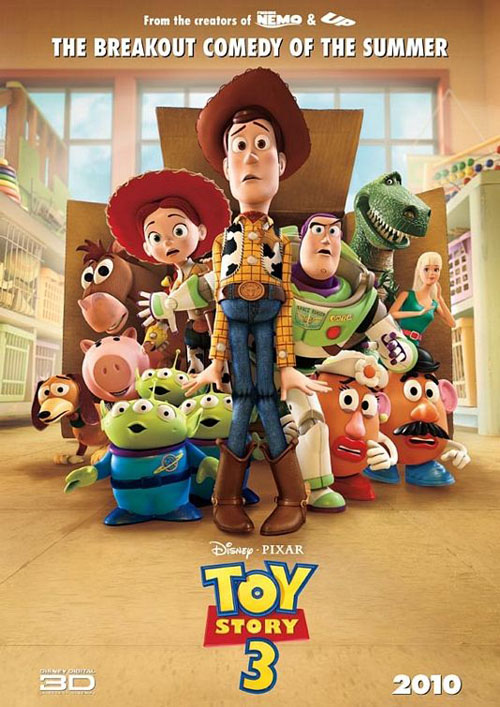
Toy Story 3 is an animated children’s film and only the third animated film ever to be nominated for a Best Picture Oscar. The odds are against TS3: firstly, it’s up against stiff competition from heavyweight films with art house sensibilities and undemanding ‘based on a true story’ crowd-pleasers. Secondly, it’s an animated children’s flick. It is highly unlikely that TS3 will walk off with the little nude man next week, but if it did it wouldn’t be the worst film Big O’s ever gone home with.
If you haven’t seen it, the plot is pretty much like the other two: Andy’s favourite toys, Woody and Buzz Lightyear, along with assorted other playthings, come to life when no one’s looking, invariably wind up far from home and have all sorts of adventures trying to get back. This time, though, the stakes are higher. Andy is all grown up and leaving for college – thanks to a misunderstanding, the toys wind up donated to a hellish day care centre instead of in storage. Even if they do make it back, only confinement in the attic awaits them. They elect for the lesser of two evils: far better to spend years in a box in case Andy has kids, than to endure endless abuse from preschoolers.

Unlike almost anything associated with Disney, TS3 is not a cynical exercise in cutesy schmaltz so saccharine it could cause diabetes. It does, however, have a strong emotional core and imparts basic morality lessons with a lightness of touch that is rare in any movie. It is also not afraid to depict children as utterly horrible: the main threat to Andy’s toys comes from a group of destructive tots too young to ‘play nicely’. The ‘bad’ toys in this film are only in conflict with Andy’s lot because they too are in fear of the ‘age inappropriate’ games. At moments like this, the animation is astonishing in its realism and its subtlety (does Buzz Lightyear’s face always freeze into that expression when someone’s around, or are we imagining the hint of rictus terror around the eyes?). The depictions, from the toys’ point of view, of their maltreatment are visceral – tongues are dragged across faces, heads repeatedly bashed against hard surfaces, bodies pulled apart. Take that, 127 Hours!
TS3 has a fantastic script and wonderful characters. Lotso, as in Lots O’ Love the teddy bear, is a stand out as the villain with a tragic past. He runs the day care centre like a prison top dog – a metaphor the film has a lot of fun with to great effect. (He’s voiced by Ned Beatty, known to most movie buffs as the ‘squealing piggy’ from Deliverance. Feel free to add your own inappropriate prison joke here.) The source of Lotso’s simmering rage is evident. The wonderful thing about day care, he tells the new arrivals, is that when the children move on new ones come to take their places. Having no owner means never being abandoned, never having your heart broken.

Lotso is a dark, complex character by any measure. Humiliated by the personal rejection of being replaced by an identical bear, he lies to his friends, telling them that they too have been replaced. Pretty heavy, even in a ‘mainstream’ film. His forebear (no pun intended) is Orson Welles as Harry Lime in The Third Man. Not only does Lotso look like Welles, he shares Lime’s amorality. Lime’s famous line, as he looks down from on high at the crowds (“Would you really feel any pity if one of those dots stopped moving forever?”) is mirrored by Lotso. “You think she’s special?” he spits at Ken as Ken tries to save Barbie. “There are millions just like her!” He even rejects his own chance at redemption, accepting Woody and Buzz’s help to save himself from a landfill fire before consciously deciding to abandon them to the same peril.
But of course, amidst the darkness, TS3 is a kids’ film. It is inventive, energetic, witty, clever and sophisticated without going over the head of its intended audience. The lighted panel on a vending machine in a dark corridor makes it the perfect substitute for a neon-lit gambling den in a back alley. The pen-ink scribbles left on a baby doll’s limbs by numerous boisterous kids are an obvious stand-in for prison tattoos. Ken spends most of his time trying to convince everyone that he’s ‘not a girls’ toy’, but confides to Barbie that until her arrival he’d been lonely because ‘no one else here really cares about clothes’. Mr Prickles, a snooty toy hedgehog voiced by former James Bond Timothy Dalton, treats each playtime as a round of improv theatre.
For all its charm, humour and verve, TS3 is a poignant film with a bitter sweet ending. The toys have a new awareness of how fleeting a kid’s childhood really is and how uncertain their future will always be. Andy gives the gang to young Molly, but it won’t be long until Molly is deciding whether to donate them or put them in the attic. Lotso’s words hang heavy in the air: “You’re plastic – made to be thrown away!”

If a movie this rewarding, engaging, thoughtful and nuanced isn’t worthy of an Oscar, what is?
Originally published on Filmwerk
Friday, 13 July 2012
Casino (1995)
Casino is rated R (Under 17 requires accompanying parent or adult guardian). It includes frequent profanity and several quick but graphic violent episodes involving beatings, a stabbing and a head caught in a vise. – The New York Times
Ah, yes. Casino. It’s the Scorsese movie that’s kind of like Goodfellas in a cocktail gown, but a lot more than that. When it came out in 1995, it seemed like a lament – for the high-flying decadence of the late 1970s and 1980s, for the dangerous, Mob-soaked glamour of Las Vegas (explicitly mourned in De Niro’s voice over in the final scenes) and for a twisted version of the American Dream itself.
The plot for Casino is based on Nicholas “co-writer of Goodfellas” Pileggi’s non-fiction book about Frank Rosenthal, who managed several casinos, including the famous Stardust, on behalf of the Chicago Mafia in the late 1970s/early 1980s. Robert De Niro and Joe Pesci – y’know, from Goodfellas, play best pals Sam “Ace” Rothstein (a thinly disguised Rosenthal) and Nicky Santoro. Ace is a dab hand at picking safe bets and handicapping them. Nicky is little and packs a punch.
As a Jew in the Italian-American world of the Mob, Ace is tolerated for the economic value of his considerable talents. He remains, nevertheless, an outsider – even Nicky, his best friend, is not above calling him a “fucking Jew” in genuine anger, during what is possibly the film’s most famous scene:
The Biblical overtones of the meeting in the desert are not accidental. Like so many of his films, Casino is shot through with Scorsese’s take on Italian-American Catholicism. Even the central, triangular relationship between Nicky, Ace and Ace’s wife Ginger that sort of reminded me of the rage and jealousy infused relationship in Jesus Christ Superstar between Judas, Christ and Magdalene. And that didn’t end so well for all concerned, either.
Sharon Stone, never better, plays Ginger, a hustler with an eye for the main chance. When Ace proposes to her she is honest about her misgivings – “I’m very fond of you, but I don’t love you” – and Ace is ready with the real hook that no one in Vegas can resist. “I’ll take care of you. You’ll want for nothing, and that’ll be true even if it doesn’t work out. Wanna take a chance?”
And of course she does – with those odds, how could she lose? But lose she does, because Ace has not got her completely figured out and refuses to fulfil his part of the deal and let her go when it “doesn’t work out”. To him, it’s obvious that all Ginger wants is money and, in fairness, she doesn’t do much to make him think otherwise.
But Ginger also has a need to be needed, and no one fills that void better than her former pimp, a loser who rejoices in the improbable name of Lester Diamond (a skeezy James Woods). Whatever else Ace feels for her, need isn’t on the list: to him, Ginger is the great gamble of his life and he can’t lose her. Ginger’s bet all she has, which isn’t much, on a rigged game. When she tries, half-heartedly, to run off with Lester, Ace lets her know who has all the cards. “I’m no john. You understand? You always thought I was but I’m not. I’m no sucker. Fucking pimp cocksucker. He’s lucky I didn’t kill him last time. Lucky he’s fucking living. And if you had stayed with him, and you would have run away, you would have been dead, both of you. Dead! Dead!”
And when Nicky, the man Ginger turns to as an unlikely ally, first claps eyes on Ginger it’s clear that, like Ace, he sees her in terms of a trophy. “What the hell have you been doing out here?” he murmurs – as though Ace’s fancy apartment, expensive clothes and wads of cash are all very well, but Ginger’s the asset that no one else can have.
Of course, Ginger’s gilded prison eventually sends her on a downward spiral of pills, booze and depression that finishes in Nicky’s pants. The set-up brilliantly misdirects where the real threat to Ace – first seen over the opening credits, tumbling through flames like a damned soul after a car bombing – comes from. In fact, it’s the old Mobsters “back home” who try to take him out after they become wary of Ace’s increasing flamboyance and penchant for ruffling the wrong feathers. Likewise, it’s not Ace’s voice over that comes from beyond the grave, but Nicky’s.
“No matter how big a guy might be, Nicky would take him on. You beat Nicky with fists, he comes back with a bat. You beat him with a knife, he comes back with a gun. And if you beat him with a gun, you better kill him, because he’ll keep comin’ back and back until one of you is dead,” Ace’s voice over tells us.
But Nicky is not immortal, and killing him doesn’t involve making sure he’s dead before putting him in a grave – he’s badly beaten and buried alive. But there’ll be no resurrecting Nicky, and Ginger gets her freedom too late. Despite eventually being allowed to walk away with a suitcase full of money and an armload of jewels, she blows it all on drugs and winds up dying in flea pit hotel. Ace, ever scrupulous about his investments, checks her out one more time. “After they found her body, I had an independent doctor do another autopsy.” Unsurprisingly, Ace finds that the Mob gave her her final hit.
Of course, Casino’s epic sweep takes in more than the story of a marriage, but the film’s three-hour running time would drag by without it. Scorsese has practised his tales of crime and the Mafia, of men doing bad things, but the destructive power of unrequited love is new territory that he handles with considerable verve. It’s not quite in the league of his greatest films (like Taxi Driver or Raging Bull), but the domestic drama at its heart brings it pretty damn close.
Originally published by Filmwerk
Ah, yes. Casino. It’s the Scorsese movie that’s kind of like Goodfellas in a cocktail gown, but a lot more than that. When it came out in 1995, it seemed like a lament – for the high-flying decadence of the late 1970s and 1980s, for the dangerous, Mob-soaked glamour of Las Vegas (explicitly mourned in De Niro’s voice over in the final scenes) and for a twisted version of the American Dream itself.
The plot for Casino is based on Nicholas “co-writer of Goodfellas” Pileggi’s non-fiction book about Frank Rosenthal, who managed several casinos, including the famous Stardust, on behalf of the Chicago Mafia in the late 1970s/early 1980s. Robert De Niro and Joe Pesci – y’know, from Goodfellas, play best pals Sam “Ace” Rothstein (a thinly disguised Rosenthal) and Nicky Santoro. Ace is a dab hand at picking safe bets and handicapping them. Nicky is little and packs a punch.
As a Jew in the Italian-American world of the Mob, Ace is tolerated for the economic value of his considerable talents. He remains, nevertheless, an outsider – even Nicky, his best friend, is not above calling him a “fucking Jew” in genuine anger, during what is possibly the film’s most famous scene:
The Biblical overtones of the meeting in the desert are not accidental. Like so many of his films, Casino is shot through with Scorsese’s take on Italian-American Catholicism. Even the central, triangular relationship between Nicky, Ace and Ace’s wife Ginger that sort of reminded me of the rage and jealousy infused relationship in Jesus Christ Superstar between Judas, Christ and Magdalene. And that didn’t end so well for all concerned, either.
Sharon Stone, never better, plays Ginger, a hustler with an eye for the main chance. When Ace proposes to her she is honest about her misgivings – “I’m very fond of you, but I don’t love you” – and Ace is ready with the real hook that no one in Vegas can resist. “I’ll take care of you. You’ll want for nothing, and that’ll be true even if it doesn’t work out. Wanna take a chance?”
And of course she does – with those odds, how could she lose? But lose she does, because Ace has not got her completely figured out and refuses to fulfil his part of the deal and let her go when it “doesn’t work out”. To him, it’s obvious that all Ginger wants is money and, in fairness, she doesn’t do much to make him think otherwise.
But Ginger also has a need to be needed, and no one fills that void better than her former pimp, a loser who rejoices in the improbable name of Lester Diamond (a skeezy James Woods). Whatever else Ace feels for her, need isn’t on the list: to him, Ginger is the great gamble of his life and he can’t lose her. Ginger’s bet all she has, which isn’t much, on a rigged game. When she tries, half-heartedly, to run off with Lester, Ace lets her know who has all the cards. “I’m no john. You understand? You always thought I was but I’m not. I’m no sucker. Fucking pimp cocksucker. He’s lucky I didn’t kill him last time. Lucky he’s fucking living. And if you had stayed with him, and you would have run away, you would have been dead, both of you. Dead! Dead!”
And when Nicky, the man Ginger turns to as an unlikely ally, first claps eyes on Ginger it’s clear that, like Ace, he sees her in terms of a trophy. “What the hell have you been doing out here?” he murmurs – as though Ace’s fancy apartment, expensive clothes and wads of cash are all very well, but Ginger’s the asset that no one else can have.
Of course, Ginger’s gilded prison eventually sends her on a downward spiral of pills, booze and depression that finishes in Nicky’s pants. The set-up brilliantly misdirects where the real threat to Ace – first seen over the opening credits, tumbling through flames like a damned soul after a car bombing – comes from. In fact, it’s the old Mobsters “back home” who try to take him out after they become wary of Ace’s increasing flamboyance and penchant for ruffling the wrong feathers. Likewise, it’s not Ace’s voice over that comes from beyond the grave, but Nicky’s.
“No matter how big a guy might be, Nicky would take him on. You beat Nicky with fists, he comes back with a bat. You beat him with a knife, he comes back with a gun. And if you beat him with a gun, you better kill him, because he’ll keep comin’ back and back until one of you is dead,” Ace’s voice over tells us.
But Nicky is not immortal, and killing him doesn’t involve making sure he’s dead before putting him in a grave – he’s badly beaten and buried alive. But there’ll be no resurrecting Nicky, and Ginger gets her freedom too late. Despite eventually being allowed to walk away with a suitcase full of money and an armload of jewels, she blows it all on drugs and winds up dying in flea pit hotel. Ace, ever scrupulous about his investments, checks her out one more time. “After they found her body, I had an independent doctor do another autopsy.” Unsurprisingly, Ace finds that the Mob gave her her final hit.
Of course, Casino’s epic sweep takes in more than the story of a marriage, but the film’s three-hour running time would drag by without it. Scorsese has practised his tales of crime and the Mafia, of men doing bad things, but the destructive power of unrequited love is new territory that he handles with considerable verve. It’s not quite in the league of his greatest films (like Taxi Driver or Raging Bull), but the domestic drama at its heart brings it pretty damn close.
Originally published by Filmwerk
Wednesday, 11 July 2012
And I, I'll drink all the time
 |
| David Bowie in 1966 |
Creator unknown
4 parts vodka.
1 part violette liqueur.
Dash of orange bitter.
1/2 part Goldschläger.
Ground cinnamon.
Stir first two ingredients with bitters over ice and strain into a chilled cocktail glass. Light a small glass of Goldshläger and pour over the drink. Dust the flame with cinnamon and serve.
The Diamond Dog
George V Hotel in Paris, France
Combine equal parts of sweet Campari, vermouth, Roses lime juice and fresh squeezed orange juice. Serve on the rocks.
Saturday, 19 May 2012
Miles Davis's South Side Chicago Chili Mack
 ¼ lb. suet (beef fat)
1 large onion
1 lb. ground beef
½ lb. ground veal
½ lb. ground pork
Salt and pepper
2 tsp. garlic powder
1 tsp. chili powder
1 tsp. cumin seed
2 cans kidney beans, drained
1 can beef consommé
1 drop red wine vinegar
3 lb. spaghetti
Parmesan cheese
Oyster crackers
Heineken beer
- Put on a Miles Davis album of your choice.
- Melt suet in large heavy pot until liquid fat is about an inch high. Remove solid pieces of suet from pot and discard.
- In same pot, sauté onion.
- Combine the meats in a bowl; season with salt, pepper, garlic powder, chili powder, and cumin.
- In another bowl, season kidney beans with salt and pepper.
- Add the meat to onions; sauté until brown.
- Add kidney beans, consommé, and vinegar; simmer for about an hour, stirring occasionally.
- Add more seasonings to taste, if desired.
- Cook spaghetti according to package directions, and then divide among six plates.
- Spoon the meat mixture over each plate of spaghetti.
- Top with Parmesan and serve oyster crackers on the side.
- Open a Heineken.
Friday, 4 May 2012
Sunday, 8 April 2012
Oliver Reed special: The Brigand of Kandahar and The Scarlet Blade
The Brigand of Kandahar
 It’s hard to imagine who this DVD release of The Brigand of Kandahar will appeal to. People who remember it fondly from when it first came out in 1965? If there’s anyone out there that applies to, congratulations. You’re the target market. Otherwise, even Oliver Reed completists will struggle to see the value in this horribly dated, racially offensive and narratively malnourished period piece from the Hammer vaults.
Ostensibly this is the tale of Lieutenant Case (Ronald Lewis), a mixed-race British officer serving in what is now Pakistan during the early days of the British Raj. After being dismissed for abandoning a fellow officer – an officer Case was cuckolding, at that – to his fate at the hands of a local resistance force, Case launches a personal vendetta against his former colonel and runs off with the “slightly mad” but much feared “Brigand of Kandahar” (Reed).
In reality, of course, this is the story of what happens when a well-intentioned story about the brutal process of colonisation and the evils of racism spectacularly misses its mark by using white actors in blackface raving in what is either poorly pronounced Pashto or, more likely, gibberish. Because I’m feeling churlish, I will also deduct marks for Ratina’s boobtacular and therefore historically inaccurate costuming.
As Ali Khan, the titular brigand, Reed has a high old time chewing on the cardboard scenery and cackling a lot. Although the pantomime camp of Reed’s performance cannot conceal that he’s wearing nugget on his face and white satin breeches on his legs, it is nevertheless very disappointing when Khan is killed off during a sabre duel with Case. Reed really looks like he’s fighting for his life – all flashing eyes, straining sinews and bared teeth. Lewis, on the other hand, looks like he’s struggling with a tricky bit of topiary.
The film’s many failings may not be so glaring had anyone bothered to invest time in developing something approaching a proper plot or meaningful characterisation. Instead, Brigand makes the most of its meagre budget by hurrying from short snatches of clunky expository dialogue to full-blown action. The battle scenes are impressive enough displays of thundering cavalry, and although some horses were sure as shit injured for the sake of realism, it wasn’t during the making of this film. Brigand’s battle scenes were culled from Zarak, a similarly-themed flick made by Warwick Films almost ten years earlier.
Jolly poor show all round.
The Scarlet Blade
 Although not quite as execrable as The Brigand of Kandahar, The Scarlet Blade is another DVD re-release from the Hammer archives that is unlikely to make anyone sigh with regret that “they don’t make films like this anymore”.
Originally released in 1964 as The Crimson Blade, the new title probably reflects the fact that the time for caring whether or not audiences notice that this is a cheap knock-off of The Scarlet Pimpernel has long since passed.
Set during the Commonwealth period, the film opens in 1649 with the arrest of Charles I. The mysterious “Scarlet Blade” is busy moving Royalist refugees to safety while Captain Judd ineptly tries to stop him. This setting at least allows Hammer to wheel out some classic Hammer-isms: dank dungeons, brocade-draped halls, and tightly laced bodices. However, it really doesn’t make the most of this last – June Thorburn, as Judd’s Royalist daughter, gets just one opportunity to show off her beautifully bolstered bosom.
Oliver Reed’s magisterial Sylvester is as enticing and as dangerous as a tiger, and he’s the best thing about this badly dated, historically dodgy curio. Amazingly, despite the setting and time-period, Hammer manage to work in a racially offensive stereotype anyway – “Pablo the Gypsy”; with his scarves, billowy shirt, pendants, gold earring and luscious hair, he looks more like a roadie for Hawkwind in blackface than a seventeenth century peon.
This flick is fine for whiling away a dreary Sunday afternoon if you happen to stumble across it on TV (the acting is not nearly as wooden as the prefabricated sets would imply), but there’s no reason to actively search it out.
These reviews were originally published on FilmWerk
Tuesday, 27 March 2012
Locked Down
Locked Down has a dirty secret. It is not a movie at all – it’s one of the world’s longest, most boring, poorly scripted commercials. The product placement for the mixed martial arts merchandisers and some-time film producers Tapout is all over the place, and for that alone Lo-Do scores well below zero on a scale of nought to zilch. If you’ve seen any of Van Damme’s vintage stuff (or, indeed, any martial arts film) then you already know the basic plot of “man must fight multiple challengers in order to win his freedom/life”, but be aware that there are plenty of spoilers lurking ahead. Just skip to the end of this review if you care whether or not there’s girl-on-girl action in it.
At least the blatant advertorial content explains Lo-Do’s existence – without it you’d be convinced that it had been made solely to make use of a disused factory and a lot of fencing wire that someone had left over. Either that, or it was conceived by some mouth-breathing lump who thought: “What if The Shawshank Redemption had been a cage fighting film, with lots of product placement, and it totally blew chunks?” This, my friends, is the answer.
To successfully pretend that Lo-Do was meant to be a real film requires being 100% more imaginative than anyone involved in its creation. It has never had an original thought pass through its meaty little head.
The script might have been pieced together using random subtitles from 70s kung fu films and The Big Book of Cliché, but that would credit the writers with some effort. Even Ian McKellan would struggle with material that could be used as an argument for giving up on language altogether, so there is no hope for star Tony Schiena, an actor so limited in range that he can’t even wear a T-shirt with conviction. Did I say star? Forgive me, I meant to say black hole. Schiena is massive and he also really sucks. His appalling lack of talent doesn’t stick out though. During the more agonising bits of poor acting, i.e. all of them, the pain could be somewhat relieved by closing your eyes and imagining that the dialogue was being delivered by the puppets from Team America.
The plot, such as it is, is that Danny (Schiena) is an honest undercover cop who is framed by crime boss Anton Vargas (Vinnie Jones). Vargas engineers it so that he and Danny wind up in the same prison, where Vargas runs a lucrative fight club with the collusion of the prison guards, including the governor, all of the prisoners and – so we’re told – a large number of people on the outside who bet on the outcomes of the fights. In fact, it’s so successful that Vargas has managed to get franchises going in other prisons! It’s all literally unbelievable.
Danny is first glimpsed beneath a Joan Jett-style party wig, trying to pass himself off as a coke dealer to the world’s smallest motorcycle gang. The four of them hang out in a disused warehouse that looks a hell of a lot like the prison where Danny will later do his lag. While two of the bikies try to convince Danny actually to do a line of coke, the other two put some half-hearted effort into cheering on a bored stripper. This is the first of many, many instances of gratuitous female nudity in the otherwise exclusively male world of Lo-Do. (The female prison guard (Bai Ling) is subjected to a vicious and misogynistic visual metaphor during a fight scene, when there’s a close-up of her face as she’s splattered with blood.)
After a bit of a shoot out, characterised by surprising ineptitude on both sides, Danny drops a bloke on his head and then goes home for rumpy pumpy with his girlfriend, who is miffed that Danny spends so much time convincingly inhabiting the skins of other people that she doesn’t even know who he is any more. If only. After a sex scene that manages to be 200 times less erotic than a detailed description of your boss’s hernia operation and 300 times more uncomfortable to endure, Danny wakes up alone. His day worsens when he is arrested by some hard nut who accuses him of shaming the memory of his father and grandfather … both of whom were cops.
In a maximum security prison with only two guards, Danny meets his mentor, Irving, an elderly black man who schools Danny on life inside. He’s also a mixed martial arts guru. Irving is intended to be the stock character Spike Lee once contemptuously dismissed as “the super-duper magical negro”, except that Lo-Do can’t manage either super-duper or magical, so he’s just a super-annoying stater of the obvious. He gets lines like “I have a bad feeling about this”, “Damn boy, looks like you got some moves” and “I’m too old for this shit”. At least Irving is always distinct. When Schiena mumbles “I fought in the cage”, it comes out as “I fart in the cage”. Who knows? Maybe that’s what he did say.
Irving is there to assure Danny that, contrary to what he might have expected, former cops are not very popular in jail, that prisoners self-segregate by race, and that the custard in the canteen is best avoided. When Irving is shot trying to escape, it’s a wonder that he doesn’t muster enough strength to mutter “Damn, I’m shot and I’m gonna die!” before expiring.
In fact, Irving’s only notable contribution is a pithy summing up of everything that’s wrong with Lo-Do. Teaching Danny a method of Japanese martial art called Wu Shu, he explains it means ‘no mind’. How apt. To compound the dumbness of this, a quick Google reveals that Wu Shu is actually Chinese for ‘martial art’.
Director Daniel Zirilli is the veteran of over 250 music videos and doesn’t even bother trying to direct an actual movie here. There’s a lot of generic hip-hop and nu-metal on the soundtrack and Zirilli takes his cue from that: not that you can blame him when the plotting, script and acting give him bugger all to work with. You can blame him for the stunning ineptitude he brings to the stuff he can control. A fight movie should have decent fights, but they’re filmed with such cack-handedness and lack of pacing that they may as well have been recorded on a cheap mobile phone.
Locked Down is so dire that even Vinnie Jones deserves better than this, but maybe that’s only because he now bears an unsettling physical resemblance to Morrissey. Avoid this sorry excuse for a movie at all costs.
*There is a catfight in this film, but it is brief, and fully-clothed. Like everything else about Locked Down, it’s a let down.
This review was originally published on FilmWerk
Tuesday, 13 March 2012
Science Fiction Double Feature with John Carpenter pt 2
Prince of Darkness
Can science defeat a bucket of green evil and Alice Cooper? Prince of Darkness uses the best of 1987’s technology in an attempt to find out.
This second instalment of Carpenter’s ‘Apocalypse trilogy’ (between 1982’s The Thing and In the Mouth of Madness (1995)) was almost universally panned on its release. “Cheesy”, “stinks” and “misfire” sum up the reviews. But despite its deliberate pacing, laugh-out-loud premise and bullshit science, this is a brainier and more interesting movie than I was expecting. Hell, Jim Emerson even saw shades of Un Chien Andalou in it.
An elderly priest dies in his sleep, clutching a small box containing a large key. He leaves behind a diary, but instead of fascinating insights like “got up early, had a bit of a pray”, it is filled with demented ravings: e.g. “I have felt the cold hellish blast”.
Meanwhile, on a leafy college campus, young people sporting mullet haircuts and polo shirts tucked into chinos dream of a world beyond green screen computers and wonder when Madonna’s 15 minutes of fame will end. Metaphysics professor Birwack (the late Victor Wong, a Carpenter stalwart) lectures on the nature of reality and unreality to a group of physics students looking for extra credit: “Say goodbye to classical reality, because our logic collapses on the sub-atomic level into ghosts and shadows!” he tells them. Every film about the son of Satan creating zombies should contain a line like this.
Birwack is then visited by an unnamed priest, played by the late Donald Pleasance (another Carpenter fave), who has used the dead priest’s key to unlock his monastery’s basement. He wants Birwack and his students to come and examine the mysterious container of agitated green liquid he’s found down there, though any fool can see it’s the Original Big Ol’ Can of Whoop Ass™.
The students are post-grads and so a bit more lived-in than the typical horror movie cannon fodder – this lot come with wedding rings, pattern baldness, myopia and burgeoning beer guts. It’s kind of a nice change. In a clear breach of academic ethics, Birwack promises them a good grade if they show willing to give up their weekends of studying/getting high/screwing in order to spend it sitting in a monastery with a big jar of pure malevolence. Thus, the first rule of horror movie set-ups is achieved: isolate your characters from the outside world.
Along the way, Carpenter manages to squeeze in a love story between mustachioed, sensitive stud muffin Brian (Jameson Parker) and emotionally distant, baggy chambray-shirt favouring Catherine (Lisa Blount, who died last year). Comic relief comes in the form of Walter (Dennis Dun, of Big Trouble in Little China). Walter can’t get his head around the concept of Schrödinger’s cat, which seems significant-ish in light of what’s in The Canister of Evil. There are also portentous shots of the sun, ant hills, and mentally ill homeless people congregating around the monastery.
It sounds like a long, slow set-up because it is. Carpenter is in no hurry; in fact, he takes such a long time that my viewing companion gave up on PoD long before the main action got going. Carpenter’s trademark score of sparse, electronic music is used almost non-stop for about the first 40 minutes, despite the fact that nothing too spooky happens. Depending on your tolerance level, either this is irritating or a good way to convey hypnotic menace. Adding to the sense of disorientation is the weird picture quality, which is apparently due to the subtle use of an anamorphic lens (which ‘squeezes’ the picture to make the images denser).
As the researchers and the priest settle in, the homeless gather quietly outside and worms start appearing on the windows en masse. The priest is accosted by one of the homeless – a woman who kisses his hand and thanks him, in sepulchral tones, for re-opening the church. He pulls away from her when he notices that the coffee cup she’s carrying is filled with maggots.
The first death, when it eventually comes, is courtesy of the ‘Street Schizo’, portrayed by Vincent Furnier, who is credited here under his stage name of Alice Cooper. Yes, that Alice Cooper. And what an odd, blackly comic death it is. An egghead exits the monastery and finds a crucified pigeon propped up outside. He then notices the singer of hits like ‘Muscle of Love’ advancing on him with a bicycle frame, upon which the hapless boffin is duly impaled. It’s worth noting that there’s nothing supernatural about this death at all, apart from the fact that ‘Street Schizo’ and the other homeless appear to be possessed.
The homeless then barricade the scientists and the priest in and the fun really begins, with a few meditations on the true nature of Satan chucked in for good measure. The most interesting of these involves the priest’s epiphany that God and Old Nick are not remotely interested in the souls of humanity and function more like matter and anti-matter. Jesus, bringer of light, is negated by the bringer of darkness (hence the ‘cold’ blast of hell). Such philosophical musings are perhaps to be expected in the confines of St Godard’s; a monastery named for a radical, existentialist film maker.
After what feels like the 7 million years the substance is estimated to have been trapped in the jar, the goo escapes and takes control of Susan the radiographer. This triggers a cute running gag, which may or may not have been inspired by Desperately Seeking Susan (1985), whereby various characters have the following exchange:
“Have you seen Susan?”
“Who?”
“Susan! The radiographer? Glasses?”
As Susan transmits the gunge by spewing it into other people’s mouths, those fortunate enough to escape her vomitous wanderings try to get some sleep. They all have the same dream, a transmission from the far-off year of 1999 in which a dark figure at the door of the monastery tries to deliver a message. At long last the green stuff comes to rest in Kelly (Susan Blanchard, yet another Carpenter regular) and she instantly manifests the advanced stages of pregnancy before ‘the bump’ seeps into her very bones and she becomes the personification of Belial’s son. This is a quick, clever way of dealing with the gestation and birth of a supernatural entity – look closely and the room this all takes place in has a ‘Nursery’ sign affixed to the door.
In another nice touch, a student infected by the green stuff seems to realise he’s possessed by evil and stabs himself in the neck in a futile effort to kill himself ‘properly’. Nevertheless, the priest is unable to bring himself to finish performing the last rites over the soon-to-be-reanimated body.
In the end, Kelly/The Demon Spawn attempts to bring ‘Father’ into the material world by reaching for him through a large mirror. This is thwarted by Catherine, who tackles her and leaps through the mirror with her just as the priest shatters it behind them. The last glimpse of Catherine is a haunting image of her seemingly outstretched in dark water, reaching back towards the shattered, fading light. It’s a simple but effective special effect.
In the final scene, Brian dreams the “transmission from 1999” dream again, but this time the figure is clearly Catherine standing with her arms straight out at her sides. He then dreams that Catherine’s disfigured corpse is in the bed next to him. He wakes up, crosses to his mirror and reaches out to touch it, whereupon the film ends.
The main message seems to be that mere mortals will have to save themselves from the clutches of eternal darkness, because although there is an omnipotent god out there somewhere, it’s not very interested in us. (“Where are you?” implores the priest more than once, eyes rolled heavenward and hands gripping his Bible.) Another timeless lesson is that, no matter how small a secret society is, after the last official member dies there will still be enough people who knew about it to go and light hundreds upon hundreds of candles in the secret basement where it used to meet.
Village of the Damned
John Carpenter’s version of Village of theDumb Damned is from the director’s awkward ‘90s phase.
As the box office returns proved, in 1995 the world was not exactly gagging for a remake of a 1960s UK/US horror film (it grossed less than half its budget). So why, for the love of Dusty, did Carpenter do it? My theory, for what it’s worth, is that in 1993 human embryos were cloned for the first time. Rather than explore the ramifications of that in an intelligent and original way, the expedient option was to raid the past.
The major problem is that Carpenter brought nothing new to what had been a post-Second World War fable about society’s unease at the rapid advancements in science and technology, and the still-fresh fear of being invaded by a foe who is like you, but with all your least appealing qualities to the fore. (It can hardly have been an accident that in both versions of the film, the children are eerily blonde, dressed alike, and march in formation.) Laziness like that is no doubt what garnered the film its Razzie nomination for ‘Worst remake or sequel’.
The strength of Carpenter’s version, if it has one, is the late Christopher Reeve in the role first played by classic English gentleman George Sanders. Richard Donner, who directed Superman, once said, “Reeve convinced me, when I met him, that Superman could fly.” As the doctor in the afflicted town of Midwich, Reeve radiates strength, compassion, dignity and intelligence. His performance here, as a grief-stricken widower trying to raise a child he cannot relate to, is grounded in a reality that this ridiculous, campy film in no way merits. This was his last role before the riding accident that shortened his life and left him quadriplegic, and he deserved better.
Instead, he is surrounded by cheap and nasty special effects and a chain-smoking, black-clad Kirstie Alley doing her best spoof of Sharon Stone in Basic Instinct. Only she and Mark Hamill, as a crazed priest with a wild look in his eye, seem to know that they’re in a B-grade flop and treat their parts with the correct level of disrespect. In fairness, Linda Kozlowski takes the same serious approach Reeve does, but the two of them were fighting a losing battle against a rising tide of schlock. The ‘glowing eyes of mind control’ are no more frightening or effective than they were in the video to Bonnie Tyler’s Total Eclipse of the Heart, and all the children seem to grow at different rates (while ‘David’ is still a baby, ‘Mara’ is already the size of a toddler) despite being conceived and born at the same time.
The children are the product of a mysterious blackout that affected everyone in the town of Midwich and left all the women of child-bearing age pregnant. Carpenter was obviously aware that other horror movies had explored the socio-political, feminist, psychological and physical aspects of conception and childbirth, because he opts not to develop those ideas here. In fact, nothing much in Village has received real attention: the still-born babe Alley whisks away in a blanket can’t be bigger than a kitten, but when its preserved remains are unveiled later in the film it’s the size of a bloated Ewok. If Carpenter’s cunning plan was to bore the viewer so much that this kind of sloppiness went unnoticed, he almost succeeded.
Can science defeat a bucket of green evil and Alice Cooper? Prince of Darkness uses the best of 1987’s technology in an attempt to find out.
This second instalment of Carpenter’s ‘Apocalypse trilogy’ (between 1982’s The Thing and In the Mouth of Madness (1995)) was almost universally panned on its release. “Cheesy”, “stinks” and “misfire” sum up the reviews. But despite its deliberate pacing, laugh-out-loud premise and bullshit science, this is a brainier and more interesting movie than I was expecting. Hell, Jim Emerson even saw shades of Un Chien Andalou in it.
An elderly priest dies in his sleep, clutching a small box containing a large key. He leaves behind a diary, but instead of fascinating insights like “got up early, had a bit of a pray”, it is filled with demented ravings: e.g. “I have felt the cold hellish blast”.
Meanwhile, on a leafy college campus, young people sporting mullet haircuts and polo shirts tucked into chinos dream of a world beyond green screen computers and wonder when Madonna’s 15 minutes of fame will end. Metaphysics professor Birwack (the late Victor Wong, a Carpenter stalwart) lectures on the nature of reality and unreality to a group of physics students looking for extra credit: “Say goodbye to classical reality, because our logic collapses on the sub-atomic level into ghosts and shadows!” he tells them. Every film about the son of Satan creating zombies should contain a line like this.
Birwack is then visited by an unnamed priest, played by the late Donald Pleasance (another Carpenter fave), who has used the dead priest’s key to unlock his monastery’s basement. He wants Birwack and his students to come and examine the mysterious container of agitated green liquid he’s found down there, though any fool can see it’s the Original Big Ol’ Can of Whoop Ass™.
The students are post-grads and so a bit more lived-in than the typical horror movie cannon fodder – this lot come with wedding rings, pattern baldness, myopia and burgeoning beer guts. It’s kind of a nice change. In a clear breach of academic ethics, Birwack promises them a good grade if they show willing to give up their weekends of studying/getting high/screwing in order to spend it sitting in a monastery with a big jar of pure malevolence. Thus, the first rule of horror movie set-ups is achieved: isolate your characters from the outside world.
Along the way, Carpenter manages to squeeze in a love story between mustachioed, sensitive stud muffin Brian (Jameson Parker) and emotionally distant, baggy chambray-shirt favouring Catherine (Lisa Blount, who died last year). Comic relief comes in the form of Walter (Dennis Dun, of Big Trouble in Little China). Walter can’t get his head around the concept of Schrödinger’s cat, which seems significant-ish in light of what’s in The Canister of Evil. There are also portentous shots of the sun, ant hills, and mentally ill homeless people congregating around the monastery.
It sounds like a long, slow set-up because it is. Carpenter is in no hurry; in fact, he takes such a long time that my viewing companion gave up on PoD long before the main action got going. Carpenter’s trademark score of sparse, electronic music is used almost non-stop for about the first 40 minutes, despite the fact that nothing too spooky happens. Depending on your tolerance level, either this is irritating or a good way to convey hypnotic menace. Adding to the sense of disorientation is the weird picture quality, which is apparently due to the subtle use of an anamorphic lens (which ‘squeezes’ the picture to make the images denser).
As the researchers and the priest settle in, the homeless gather quietly outside and worms start appearing on the windows en masse. The priest is accosted by one of the homeless – a woman who kisses his hand and thanks him, in sepulchral tones, for re-opening the church. He pulls away from her when he notices that the coffee cup she’s carrying is filled with maggots.
The first death, when it eventually comes, is courtesy of the ‘Street Schizo’, portrayed by Vincent Furnier, who is credited here under his stage name of Alice Cooper. Yes, that Alice Cooper. And what an odd, blackly comic death it is. An egghead exits the monastery and finds a crucified pigeon propped up outside. He then notices the singer of hits like ‘Muscle of Love’ advancing on him with a bicycle frame, upon which the hapless boffin is duly impaled. It’s worth noting that there’s nothing supernatural about this death at all, apart from the fact that ‘Street Schizo’ and the other homeless appear to be possessed.
The homeless then barricade the scientists and the priest in and the fun really begins, with a few meditations on the true nature of Satan chucked in for good measure. The most interesting of these involves the priest’s epiphany that God and Old Nick are not remotely interested in the souls of humanity and function more like matter and anti-matter. Jesus, bringer of light, is negated by the bringer of darkness (hence the ‘cold’ blast of hell). Such philosophical musings are perhaps to be expected in the confines of St Godard’s; a monastery named for a radical, existentialist film maker.
After what feels like the 7 million years the substance is estimated to have been trapped in the jar, the goo escapes and takes control of Susan the radiographer. This triggers a cute running gag, which may or may not have been inspired by Desperately Seeking Susan (1985), whereby various characters have the following exchange:
“Have you seen Susan?”
“Who?”
“Susan! The radiographer? Glasses?”
As Susan transmits the gunge by spewing it into other people’s mouths, those fortunate enough to escape her vomitous wanderings try to get some sleep. They all have the same dream, a transmission from the far-off year of 1999 in which a dark figure at the door of the monastery tries to deliver a message. At long last the green stuff comes to rest in Kelly (Susan Blanchard, yet another Carpenter regular) and she instantly manifests the advanced stages of pregnancy before ‘the bump’ seeps into her very bones and she becomes the personification of Belial’s son. This is a quick, clever way of dealing with the gestation and birth of a supernatural entity – look closely and the room this all takes place in has a ‘Nursery’ sign affixed to the door.
In another nice touch, a student infected by the green stuff seems to realise he’s possessed by evil and stabs himself in the neck in a futile effort to kill himself ‘properly’. Nevertheless, the priest is unable to bring himself to finish performing the last rites over the soon-to-be-reanimated body.
In the end, Kelly/The Demon Spawn attempts to bring ‘Father’ into the material world by reaching for him through a large mirror. This is thwarted by Catherine, who tackles her and leaps through the mirror with her just as the priest shatters it behind them. The last glimpse of Catherine is a haunting image of her seemingly outstretched in dark water, reaching back towards the shattered, fading light. It’s a simple but effective special effect.
In the final scene, Brian dreams the “transmission from 1999” dream again, but this time the figure is clearly Catherine standing with her arms straight out at her sides. He then dreams that Catherine’s disfigured corpse is in the bed next to him. He wakes up, crosses to his mirror and reaches out to touch it, whereupon the film ends.
The main message seems to be that mere mortals will have to save themselves from the clutches of eternal darkness, because although there is an omnipotent god out there somewhere, it’s not very interested in us. (“Where are you?” implores the priest more than once, eyes rolled heavenward and hands gripping his Bible.) Another timeless lesson is that, no matter how small a secret society is, after the last official member dies there will still be enough people who knew about it to go and light hundreds upon hundreds of candles in the secret basement where it used to meet.
Village of the Damned
John Carpenter’s version of Village of the
As the box office returns proved, in 1995 the world was not exactly gagging for a remake of a 1960s UK/US horror film (it grossed less than half its budget). So why, for the love of Dusty, did Carpenter do it? My theory, for what it’s worth, is that in 1993 human embryos were cloned for the first time. Rather than explore the ramifications of that in an intelligent and original way, the expedient option was to raid the past.
The major problem is that Carpenter brought nothing new to what had been a post-Second World War fable about society’s unease at the rapid advancements in science and technology, and the still-fresh fear of being invaded by a foe who is like you, but with all your least appealing qualities to the fore. (It can hardly have been an accident that in both versions of the film, the children are eerily blonde, dressed alike, and march in formation.) Laziness like that is no doubt what garnered the film its Razzie nomination for ‘Worst remake or sequel’.
The strength of Carpenter’s version, if it has one, is the late Christopher Reeve in the role first played by classic English gentleman George Sanders. Richard Donner, who directed Superman, once said, “Reeve convinced me, when I met him, that Superman could fly.” As the doctor in the afflicted town of Midwich, Reeve radiates strength, compassion, dignity and intelligence. His performance here, as a grief-stricken widower trying to raise a child he cannot relate to, is grounded in a reality that this ridiculous, campy film in no way merits. This was his last role before the riding accident that shortened his life and left him quadriplegic, and he deserved better.
Instead, he is surrounded by cheap and nasty special effects and a chain-smoking, black-clad Kirstie Alley doing her best spoof of Sharon Stone in Basic Instinct. Only she and Mark Hamill, as a crazed priest with a wild look in his eye, seem to know that they’re in a B-grade flop and treat their parts with the correct level of disrespect. In fairness, Linda Kozlowski takes the same serious approach Reeve does, but the two of them were fighting a losing battle against a rising tide of schlock. The ‘glowing eyes of mind control’ are no more frightening or effective than they were in the video to Bonnie Tyler’s Total Eclipse of the Heart, and all the children seem to grow at different rates (while ‘David’ is still a baby, ‘Mara’ is already the size of a toddler) despite being conceived and born at the same time.
The children are the product of a mysterious blackout that affected everyone in the town of Midwich and left all the women of child-bearing age pregnant. Carpenter was obviously aware that other horror movies had explored the socio-political, feminist, psychological and physical aspects of conception and childbirth, because he opts not to develop those ideas here. In fact, nothing much in Village has received real attention: the still-born babe Alley whisks away in a blanket can’t be bigger than a kitten, but when its preserved remains are unveiled later in the film it’s the size of a bloated Ewok. If Carpenter’s cunning plan was to bore the viewer so much that this kind of sloppiness went unnoticed, he almost succeeded.
Monday, 12 March 2012
Science Fiction Double Feature with John Carpenter pt 1
Escape from LA
The walking, one-eyed phallic symbol that is ‘Snake’ Plissken is back. For some reason.
In 1981, Escape from New York inspired a young Robert Rodriguez and became a near-instant cult classic. It is rumoured that Carpenter conceived the plot as a response to the Watergate scandal, but confused studio bosses by handing them a script about a dystopian future where New York has become a maximum security prison and the kidnapped US President has to be rescued from it by a one-eyed bank robber. Though they turned the script upside down, had it translated into several languages and tried reading it at midnight whilst sky-clad and drinking pig’s blood, the studio execs still couldn’t figure out what the hell it had to do with Watergate. “No,” they said.
All that changed when Halloween, Carpenter’s response to the rise of Quebecoise separatism cunningly disguised as a slasher flick, did good box office. The studio execs re-examined the script for Escape from New York, and though it was still baffling they decided to greenlight it. The process for getting 1996’s Escape from LA from go to whoa (woe?) was easier and can be summed up as: $ + $ = $$. Hundreds of people were hired to do the special effects that the film heavily relies on. Since those same effects can now be achieved by any mouth-breather with a laptop, Escape from LA’s laughably cheap and dated look can be added to its long list of failings.
Snake (Kurt Russell) slithers back into being in 1996, when Los Angeles is the new American hell hole thanks to a devastating earthquake that has separated the city from the mainland. Here, the USA’s moral undesirables are exiled and rendered stateless. The recent disasters in Japan, Haiti and New Zealand make the images of a city in ruins a lot more upsetting than they deserve to be, but this poignancy doesn’t last long thanks to the ensuing tsunami of dross. The plot is 98% the same as the first instalment, except this time it’s the President’s daughter in a pickle and Snake’s not meant to save her.
Young Utopia has been ‘groomed’ online by a terrorist, Cuervo Jones, who has convinced her to rebel against the totalitarian regime headed by her Christian fundamentalist father. This involves Utopia hijacking Air Force One all on her lonesome, seizing some kind of doomsday device and then escaping to L.A. where she gifts the weapon to Jones. Jones is supposed to be Snake’s main opposition, but he is as charisma-free and devoid of menace as you could wish. His Che Guevara costume doesn’t compensate for a complete lack of magnetism. This guy couldn’t convince a single person to follow him on Twitter, let alone brainwash a privileged brat into giving up her life of luxury for the chance to wear hot pants and spend her days dodging bullets.
Snake is dragged in and forced, through means too implausible to mention, to bring the weapon back and execute the First Daughter.
When, in 2007, the idea of remaking Escape from New York with Gerard Butler in the role of Snake was floated, Russell was less than impressed. “I will say that when I was told who was going to play Snake Plissken, my initial reaction was ‘Oh, man!.’ I do think that character was quintessentially one thing. And that is, American.” This chauvinism is all over Escape from LA like fake tan.
It manifests itself as a complete lack of humour, despite the fact that Escape from LA shoves its tongue so far into its cheek it does itself an injury. (For example, a Great White shark snaps at Snake’s speeding submarine, and Peter Fonda and Snake surf a wave down Rodeo Drive.) A very brief scene, in which Snake and his new-found Muslim best friend (Valeria Golino) are kidnapped for body parts by plastic surgery addicts, is as ham-fisted an attempt at satire as has ever been filmed. Even Bruce Campbell, barely recognisable under all the prosthetics as LA’s surgeon general, can’t rescue it. Once out of the doctor’s clutches, Golino makes a half-hearted pass at Snake which he rebuffs. She declares that LA isn’t so bad “once you get used to it” and is shot dead by a Korean gang.
The fate of Golino’s brazen hussy is at least doled out faster than Utopia’s horrible plotline, which goes like this: a young white girl, from a ‘good’ Christian home, runs away to the slums to live with a violent Latino crime boss who psychologically and physically dominates her. Her father’s response is to send an assassin after her. Not only is Utopia’s story all about the male domination of women, it’s also a blatant expression of racist, psychosexual nightmares. I am not alone in seeing unpleasant undertones beneath Escape from LA’s cheerful meat-headisms.
Scott Bukatman describes the two Snake Plissken films as ‘white man’s revenge’ stories, and cites the ‘shooting hoops’ scene as an example. In this scene, Jones locks Snake on a basketball court and sets him the near-impossible task of shooting 10 points in 10 seconds in order to avoid execution. When Snake succeeds, the mainly black and Hispanic crowd stop baying for his blood and start chanting his name. “This town,” observes Steve Buscemi, “loves a winner.” Between scenes like these, the casual murder of Golino’s character, Utopia’s constant tears, and the bizarre treatment of Pam Grier, Escape from LA looks like the ultimate middle finger to liberal values.
Grier has most reason to feel bitter. She plays a transsexual version of Carjack Malone with an over-dubbed voice and a wardrobe pinched from Tina Turner in Mad Max: Beyond Thunderdome. On their first encounter, Snake recognises her and runs his hand up her leg to her crotch, where he discovers a gun that he takes away from her. (Paging Dr Freud etc.) Needless to say, no black transsexuals make it out of LA.
Happily, however, even in the olden days of 1996 Snake was a man out of step with the times and Escape from LA was a bomb. Of the Carpenter films I’ve watched for this retrospective, this was the only one I found to be not only tedious beyond redemption, but offensive and boorish as well. Plissken’s not so much a snake as an utter dick.
Ghosts of Mars
Death metal fans and feminists in space! Doesn’t sound bad, does it? But 2001’s Ghosts of Mars is not, in any way, ‘good’. Or, indeed, ‘watchable’.
For a start, Ice Cube plays someone named James ‘Desolation’ Williams. Yep, you read that right. His nickname, which everyone calls him by even though it is the most rubbish nickname in the history of the world, is longer than his actual name. That’s how bad Ghosts of Mars is: even the names are utter pants. The only interesting thing about this film is the light it might shed on Carpenter’s feelings for Pam Grier. In Escape from LA she’s a ball-breaking transsexual who dies at the end, here she’s a ball-breaking lesbian in a long leather coat who winds up being decapitated and having her head shoved on a stick. Let us all take a moment to stroke our goatees in contemplation of what these facts might tell us about Carpenter’s psyche.
The plot is really stupid so I won’t waste much time on it, but it’s set in the not-too-distant future on, erm, Mars, which is controlled by a matriarchy that is in thrall to a mining cartel. Mining communities are being gripped by a mass psychosis that results in them dressing up like members of Scandinavian death metal bands and slaughtering anyone not likewise afflicted. It is not exactly a penny-drop moment when scientist Joanna Cassidy reveals that these people are possessed by ‘the ghosts of Mars’. The Martians have been awakened from slumber by all the tunnelling and what-not, and are now using their corporeal hosts to butcher the human invaders and to manifest their own brutal take on the ‘urban primitive’ aesthetic that was so popular in the 1990s – think daggers used as facial piercing adornments and severed hands as breast plates.
Natasha Henstridge (Lieutenant Melanie Ballard) and Pam Grier play cops leading a small team to such a community, unaware that, as Desolation puts it, ‘shit is getting real right here’. (Just so we’re clear, the dialogue is hopeless.) The team’s mission is to collect Desolation, a remand prisoner, and bring him back to the capital for trial. The story unfolds from Melanie’s point of view as she explains to a tribunal how she came to be found drugged and alone on a mining train set to autopilot.
The team’s assignment takes on shades of what Carpenter plainly hoped would be a classic Western when they attempt to rescue the few unafflicted people left and avoid getting dosed with ghost themselves. There is much running, and things exploding, and nasty blades being waved around, Jason Statham, and the self-mutilated townsfolk hurling missiles from rooftops along the main street as our rag-tag band of cops, survivors and criminals dash for the last train out of town. They make it, but Melanie orders the driver to go back so they can destroy the settlement. Alas, after this second assault, only Melanie and Desolation survive. Whoops, spoiled the ending!
The Martians don’t speak English, but are mad keen on howling, yelling, and rallying each other with their stirring cry of “Voar! Rob-trotewolf! Asidjowoewah!” This is much better than the dialogue Henstridge and Statham (as the significantly named Sgt Jericho) get in their scenes together. These consist of Jericho pestering Melanie to take advantage of his massive penis, and the glassy-eyed Henstridge attempting a facial expression in response. Bogart and Bacall it’s not, and the later ‘odd couple’ pairing of Melanie and Desolation is no more successful thanks to Henstridge having the emotional depth of an oyster.
As a double-whammy non-payoff, not only has Melanie been telling the truth (I was hoping for a twist unmasking her as an unreliable narrator), but the ending – oh dear God, no! – leaves the way open for a sequel.
To sum up: Ghosts of Mars teaches us that John Carpenter is afraid of both sexy, sexy Pam Grier and the fashion sense of Finnish metallers Lordi. When Alfred Hitchcock said “Always make the audience suffer as much as possible”, this great steaming pile of asidjowoewah is not what he had in mind.
These retrospectives were originally posted on Filmwerk.co.uk
Subscribe to:
Posts (Atom)