Saturday, 28 July 2012

Jack Falls (2011)

Jack Falls, the third and last instalment in the film adaptations of Paul Tanter’s Jack graphic novels, aims to be a British Sin City. It’s closer to that other Frank Miller film, The Spirit, which opened to poor reviews and quickly fled cinemas with its hands over its butt to shield itself from a good kicking.


The ‘black and white with flashes of colour’ gimmick may have long since lost its impact, but Jack Falls is not without its assets. Dexter Fletcher isn’t given nearly enough screen time as a rumpled-yet-honest detective and Tamer Hassan rumbles his lines as though the spirits of both Kray twins are battling for possession of his 6’3” frame. Despite the shoe-string budget there are some decent action sequences and the locations are used effectively, if without imagination. Even though expository dialogue is kept to a merciful minimum, audiences who haven’t seen the first two films won’t have any difficulty following the action.

On the other hand, Alan Ford (the under-funded British film’s ersatz Ray Winstone) plays the same East End gangsta he always does, and Simon Phillips as the hero doesn’t contribute much beyond Olympic-level frowning. Phillips is also, if anything, too much of an everyman to be believable as a tragic, angst-ridden agent of violence.


While it may have seemed like a good idea to let Tanter write the screenplay and co-direct, his obvious reluctance to tinker with his own source material leaves the actors choking out dialogue that was never designed to be spoken aloud. In more assured hands this tale of bloody revenge carried out by a self-destructive, tormented anti-hero should have been able to achieve some success in spite of its flaws, but as it is the overall effect is like watching a noir Eastenders.


Originally published by Filmwerk

Saturday, 21 July 2012

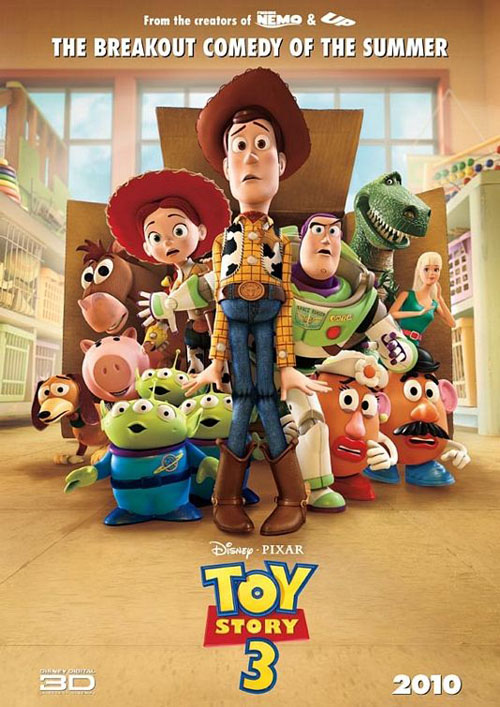
Toy Story 3 (2010)


Toy Story 3 is an animated children’s film and only the third animated film ever to be nominated for a Best Picture Oscar. The odds are against TS3: firstly, it’s up against stiff competition from heavyweight films with art house sensibilities and undemanding ‘based on a true story’ crowd-pleasers. Secondly, it’s an animated children’s flick. It is highly unlikely that TS3 will walk off with the little nude man next week, but if it did it wouldn’t be the worst film Big O’s ever gone home with.

If you haven’t seen it, the plot is pretty much like the other two: Andy’s favourite toys, Woody and Buzz Lightyear, along with assorted other playthings, come to life when no one’s looking, invariably wind up far from home and have all sorts of adventures trying to get back. This time, though, the stakes are higher. Andy is all grown up and leaving for college – thanks to a misunderstanding, the toys wind up donated to a hellish day care centre instead of in storage. Even if they do make it back, only confinement in the attic awaits them. They elect for the lesser of two evils: far better to spend years in a box in case Andy has kids, than to endure endless abuse from preschoolers.


Unlike almost anything associated with Disney, TS3 is not a cynical exercise in cutesy schmaltz so saccharine it could cause diabetes. It does, however, have a strong emotional core and imparts basic morality lessons with a lightness of touch that is rare in any movie. It is also not afraid to depict children as utterly horrible: the main threat to Andy’s toys comes from a group of destructive tots too young to ‘play nicely’. The ‘bad’ toys in this film are only in conflict with Andy’s lot because they too are in fear of the ‘age inappropriate’ games. At moments like this, the animation is astonishing in its realism and its subtlety (does Buzz Lightyear’s face always freeze into that expression when someone’s around, or are we imagining the hint of rictus terror around the eyes?). The depictions, from the toys’ point of view, of their maltreatment are visceral – tongues are dragged across faces, heads repeatedly bashed against hard surfaces, bodies pulled apart. Take that, 127 Hours!

TS3 has a fantastic script and wonderful characters. Lotso, as in Lots O’ Love the teddy bear, is a stand out as the villain with a tragic past. He runs the day care centre like a prison top dog – a metaphor the film has a lot of fun with to great effect. (He’s voiced by Ned Beatty, known to most movie buffs as the ‘squealing piggy’ from Deliverance. Feel free to add your own inappropriate prison joke here.) The source of Lotso’s simmering rage is evident. The wonderful thing about day care, he tells the new arrivals, is that when the children move on new ones come to take their places. Having no owner means never being abandoned, never having your heart broken.


Lotso is a dark, complex character by any measure. Humiliated by the personal rejection of being replaced by an identical bear, he lies to his friends, telling them that they too have been replaced. Pretty heavy, even in a ‘mainstream’ film. His forebear (no pun intended) is Orson Welles as Harry Lime in The Third Man. Not only does Lotso look like Welles, he shares Lime’s amorality. Lime’s famous line, as he looks down from on high at the crowds (“Would you really feel any pity if one of those dots stopped moving forever?”) is mirrored by Lotso. “You think she’s special?” he spits at Ken as Ken tries to save Barbie. “There are millions just like her!” He even rejects his own chance at redemption, accepting Woody and Buzz’s help to save himself from a landfill fire before consciously deciding to abandon them to the same peril.
But of course, amidst the darkness, TS3 is a kids’ film. It is inventive, energetic, witty, clever and sophisticated without going over the head of its intended audience. The lighted panel on a vending machine in a dark corridor makes it the perfect substitute for a neon-lit gambling den in a back alley. The pen-ink scribbles left on a baby doll’s limbs by numerous boisterous kids are an obvious stand-in for prison tattoos. Ken spends most of his time trying to convince everyone that he’s ‘not a girls’ toy’, but confides to Barbie that until her arrival he’d been lonely because ‘no one else here really cares about clothes’. Mr Prickles, a snooty toy hedgehog voiced by former James Bond Timothy Dalton, treats each playtime as a round of improv theatre.

For all its charm, humour and verve, TS3 is a poignant film with a bitter sweet ending. The toys have a new awareness of how fleeting a kid’s childhood really is and how uncertain their future will always be. Andy gives the gang to young Molly, but it won’t be long until Molly is deciding whether to donate them or put them in the attic. Lotso’s words hang heavy in the air: “You’re plastic – made to be thrown away!”


If a movie this rewarding, engaging, thoughtful and nuanced isn’t worthy of an Oscar, what is?


Originally published on Filmwerk

Friday, 13 July 2012

Casino (1995)

Casino is rated R (Under 17 requires accompanying parent or adult guardian). It includes frequent profanity and several quick but graphic violent episodes involving beatings, a stabbing and a head caught in a vise.  – The New York Times

Ah, yes. Casino. It’s the Scorsese movie that’s kind of like Goodfellas in a cocktail gown, but a lot more than that. When it came out in 1995, it seemed like a lament – for the high-flying decadence of the late 1970s and 1980s, for the dangerous, Mob-soaked glamour of Las Vegas (explicitly mourned in De Niro’s voice over in the final scenes) and for a twisted version of the American Dream itself.

The plot for Casino is based on Nicholas “co-writer of Goodfellas” Pileggi’s non-fiction book about Frank Rosenthal, who managed several casinos, including the famous Stardust, on behalf of the Chicago Mafia in the late 1970s/early 1980s. Robert De Niro and Joe Pesci – y’know, from Goodfellas, play best pals Sam “Ace” Rothstein (a thinly disguised Rosenthal) and Nicky Santoro. Ace is a dab hand at picking safe bets and handicapping them. Nicky is little and packs a punch.

As a Jew in the Italian-American world of the Mob, Ace is tolerated for the economic value of his considerable talents. He remains, nevertheless, an outsider – even Nicky, his best friend, is not above calling him a “fucking Jew” in genuine anger, during what is possibly the film’s most famous scene:


The Biblical overtones of the meeting in the desert are not accidental. Like so many of his films, Casino is shot through with Scorsese’s take on Italian-American Catholicism. Even the central, triangular relationship between Nicky, Ace and Ace’s wife Ginger that sort of reminded me of the rage and jealousy infused relationship in Jesus Christ Superstar between Judas, Christ and Magdalene. And that didn’t end so well for all concerned, either.

Sharon Stone, never better, plays Ginger, a hustler with an eye for the main chance. When Ace proposes to her she is honest about her misgivings – “I’m very fond of you, but I don’t love you” – and Ace is ready with the real hook that no one in Vegas can resist. “I’ll take care of you. You’ll want for nothing, and that’ll be true even if it doesn’t work out. Wanna take a chance?”
And of course she does – with those odds, how could she lose? But lose she does, because Ace has not got her completely figured out and refuses to fulfil his part of the deal and let her go when it “doesn’t work out”. To him, it’s obvious that all Ginger wants is money and, in fairness, she doesn’t do much to make him think otherwise.

But Ginger also has a need to be needed, and no one fills that void better than her former pimp, a loser who rejoices in the improbable name of Lester Diamond (a skeezy James Woods). Whatever else Ace feels for her, need isn’t on the list: to him, Ginger is the great gamble of his life and he can’t lose her. Ginger’s bet all she has, which isn’t much, on a rigged game. When she tries, half-heartedly, to run off with Lester, Ace lets her know who has all the cards. “I’m no john. You understand? You always thought I was but I’m not. I’m no sucker. Fucking pimp cocksucker. He’s lucky I didn’t kill him last time. Lucky he’s fucking living. And if you had stayed with him, and you would have run away, you would have been dead, both of you. Dead! Dead!”

And when Nicky, the man Ginger turns to as an unlikely ally, first claps eyes on Ginger it’s clear that, like Ace, he sees her in terms of a trophy. “What the hell have you been doing out here?” he murmurs – as though Ace’s fancy apartment, expensive clothes and wads of cash are all very well, but Ginger’s the asset that no one else can have.

Of course, Ginger’s gilded prison eventually sends her on a downward spiral of pills, booze and depression that finishes in Nicky’s pants. The set-up brilliantly misdirects where the real threat to Ace – first seen over the opening credits, tumbling through flames like a damned soul after a car bombing – comes from. In fact, it’s the old Mobsters “back home” who try to take him out after they become wary of Ace’s increasing flamboyance and penchant for ruffling the wrong feathers. Likewise, it’s not Ace’s voice over that comes from beyond the grave, but Nicky’s.

“No matter how big a guy might be, Nicky would take him on. You beat Nicky with fists, he comes back with a bat. You beat him with a knife, he comes back with a gun. And if you beat him with a gun, you better kill him, because he’ll keep comin’ back and back until one of you is dead,” Ace’s voice over tells us.

But Nicky is not immortal, and killing him doesn’t involve making sure he’s dead before putting him in a grave – he’s badly beaten and buried alive. But there’ll be no resurrecting Nicky, and Ginger gets her freedom too late. Despite eventually being allowed to walk away with a suitcase full of money and an armload of jewels, she blows it all on drugs and winds up dying in flea pit hotel. Ace, ever scrupulous about his investments, checks her out one more time. “After they found her body, I had an independent doctor do another autopsy.” Unsurprisingly, Ace finds that the Mob gave her her final hit.

Of course, Casino’s epic sweep takes in more than the story of a marriage, but the film’s three-hour running time would drag by without it. Scorsese has practised his tales of crime and the Mafia, of men doing bad things, but the destructive power of unrequited love is new territory that he handles with considerable verve. It’s not quite in the league of his greatest films (like Taxi Driver or Raging Bull), but the domestic drama at its heart brings it pretty damn close.


Originally published by Filmwerk

Wednesday, 11 July 2012

And I, I'll drink all the time

David Bowie in 1966
The Ziggy Stardust
Creator unknown

4 parts vodka.
1 part violette liqueur.
Dash of orange bitter.
1/2 part Goldschläger.
Ground cinnamon.

Stir first two ingredients with bitters over ice and strain into a chilled cocktail glass. Light a small glass of Goldshläger and pour over the drink.  Dust the flame with cinnamon and serve.

The Diamond Dog
George V Hotel in Paris, France

Combine equal parts of sweet Campari, vermouth, Roses lime juice and fresh squeezed orange juice. Serve on the rocks.