Not usually my cup of musical tea, but it's damn catchy and the video is based on the 1956 Burt Lancaster vehicle Trapeze. Solid.
Friday, 25 November 2011

Wednesday, 16 November 2011
Friday, 11 November 2011
Fire Down Below (1997)
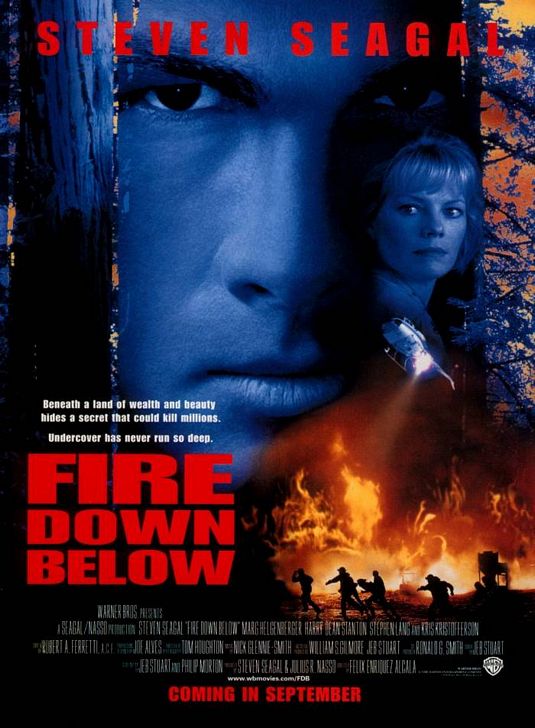
Let’s get the obvious out of the way first: despite the title, Fire Down Below (1997) is not about sexually transmitted infections, although if Steven Seagal’s parents had not had sex it’s arguable that the world of straight-to-DVD releases would be much poorer.
Fire Down Below was made during Mr Seagal’s eco-warrior phase. Please, stop laughing: never before has Mother Nature had her honour defended with so much ass kicking and bluegrass music. Set in the Appalachian mountains, it begins with Mr Seagal using green screen technology to pilot a small plane through a breathtakingly beautiful wilderness. In sepia-toned flashbacks, we’re told that his character is an environmental protection agent and on his way to avenge – oh, I’m sorry, investigate – the mysterious murder of his friend in a small mining town where evil Kris Kristofferson’s evil company is disposing of toxic waste in the disused mine shafts. And really, what more environmentally friendly way to travel is there than by private plane?
On the soundtrack, some dude bellows over a steel guitar about a “copperhead sittin’ on a sycamore log”. If you don’t like country music and its associated genres, then Fire Down Below is going to go out of its way to alienate you. This is a film that cannot get to grips with the idea that not every scene requires some form of hootenanny on the soundtrack.
Aided by the town’s kindly preacher, Mr Seagal’s flimsy cover story is that he’s in town to help the locals rebuild their collapsing shacks, and, as a bonus, blow them all away with his awesome guitar chops. A sheriff in the pocket of the corporation warns Mr Seagal that he’s seen his kind before: “Drunks. Bums. Ex-cons. All tryin’ to atone for somethin’.” Or, as Mr Seagal serenely puts it, “I’m just here doing God’s work.” And you know what? The bastard probably believes it.
A couple of points here.
Firstly, no, I didn’t bother learning the name of Mr Seagal’s character. There was no point because Steven Seagal’s character is always Steven Seagal. This is why Steven Seagal is not a bad actor: to be a bad actor, first you need to try to act. You are not an actor if, in all of your roles, you have the same haircut, the same outfits (in fairness, at one point in this film Mr Seagal does sport a spectacularly ugly jacket with a bright, Aztec-style print) and the same narrow-eyed delivery of terrible/great dialogue, including this unintentionally flirtatious exchange:
Kristofferson: You’re violating my constitutional rights.
Seagal: I’ll show you a new meaning to the word ‘violation’.
Secondly, for a film in which Mr Seagal spends a great deal of time speechifyin’ about how the evil mining company is treatin’ the good people of this community like dumb hillbilly hicks, it spends a great deal of time depicting the people of the Appalachian mountains as dumb hillbilly hicks.
The notable exception to this rule is Mr Seagal’s putative love interest, Sarah (a pre-botox Marg Helgenberger). Sarah keeps bees and sells honey, which doesn’t bring her in much money on account of her having murdered her daddy when she was 16 and the townsfolk never having forgiven her for it. Within five minutes of meeting her Mr Seagal works out what the dumb hillbilly hicks haven’t been able to in nearly 20 years: Sarah’s brother killed their father when the old man worked out that Sarah’s brother had been molesting her. To make the point even clearer and more repellent, Sarah’s brother calls her a whore and promises her that after he’s killed Mr Seagal, “Things will go back to the way they were when daddy was alive.” Because, you know, that’s how men who live outside cities and don’t have a lot of money behave towards their sisters.
Faster than you can say “the perpetuation of grossly offensive stereotypes of the rural poor”, toothless thugs clad in dungarees and checked shirts are hiding venomous snakes in Mr Seagal’s bedroom, attempting to violently assault him in pool halls, and showing him the kind of cheerful small-town hospitality that consists of greeting strangers with “Fuck are you doin’ here, pretty boy?” The funniest thing about this is that even by the scrofulent standards of the locals, Mr Seagal is still not “pretty”.
A “hilarious” exchange in which Mr Seagal compares his would-be assailants to the supporting cast of Deliverance before beating them senseless only serves to remind viewers that they could be watching a much better film. At various other points, Mr Seagal threatens to shoot dead a sheriff’s deputy and hands a gun to a young boy with instructions on how to use it. Anywhere else in the world such behaviour would be considered sociopathic: in Fire Down Below this is the way the good guy gets shit done.
After a pretty decent pick-up vs Mac truck chase scene, set to Hendrix’s Little Wing for some reason, Mr Seagal storms back into town with a new and artfully placed cut on his cheekbone. He interrupts the preacher mid-sermon to literally preach to the townsfolk about their responsibilities to the environment and future generations. Presumably to prevent such a horrific instance of pulpit abuse from ever happening again, the church is later burned to the ground in scenes that will gladden the heart of any Norwegian black metal fan.
The film closes with the legendary Harry Dean Stanton wearing denim overalls, sitting on his new, Seagal-built porch and playing the guitar and singing. He’s pretty good, too. But this brief vignette is in no way a big enough dollop of ointment to soothe the itchy, irritating and lingering effects that come from wasting a couple of hours of your life on Fire Down Below.
Originally published by Filmwerk
Friday, 4 November 2011
Siren (2010)
At the heart of Siren is a great idea that could revitalise the horror genre (stay with me). Zombies are so hot right now, but they are not sexy (unless, of course, you are a very specific kind of necrophiliac, in which case ... ew). Vampires are totally sexy, but they are a bit 2009 and plus, there’s the whole Twilight-wussification thing. The ghouls populating the likes of Paranormal Activity and The Blair Witch Project have no screen presence – who knows if they’re sexy or not? The film world is crying out for the next big thing in hot supernatural beings who want to kill us.
Perhaps Siren provides the answer, if nothing else. Mermaids, after all, are probably where we get the term ‘dead sexy’. As far as horror goes, they are also an untapped resource. The Little Mermaid has a lot to answer for: the mermaids of Greek myth were dreadful old-school style. They hung out on rocks in all weathers, crooning to lonely passing sailors only to lure them to their deaths. Their only purpose was to look gorgeous from the waist up and ensure that men died horrible deaths that involved their bodies being bashed to smithereens on razor-sharp rocks and their lungs filled with sea water. But as we know, mermaids have bare bosoms and they don’t have any lady-bits Down There: female sexuality is so scary that even the fictional embodiments of it aren’t allowed hoo-hahs.
Sadly, Siren is also lacking in crucial areas. The film opens promisingly enough, with lovely brunette Lindsay Lohan-lookalike Anna Skellern nearly causing her beefcake boyfriend to crash their car just because she’s so damn attractive. (Yes, this is a portent of things to come.) Beefcake and Brunette then pick up Brunette’s ex-boyfriend, World Travelling Guy. We can tell he is more sensitive than Beefcake because unlike Beefcake he doesn’t earn tons of money and he wears pendants on leather thongs around his neck.
The three of them go on a sailing holiday (top tip: don’t travel on a boat named for Persephone, Queen of the Underworld) that capsizes when they rescue an emaciated dude from a deserted island only moments before he starts bleeding from the ears and drops dead. Going ashore to bury him (on the flimsiest pretext imaginable), the trio meet Silka (Tereza Srbova). Given the title, it’s not a spoiler to tell you that she is The Most Uncharismatic Mermaid Ever™.
Srbova is more dead fish than alluring femme fatale, and she helps to sink Siren faster than you can say “But the whole film stinks.” As soon as the credits rolled I had trouble remembering what she looked like, beyond “pretty, blonde.” Even her allegedly mesmerising song of doom is an instantly forgettable bit of pop-lite fluff. And why does it take her so long to get around to singing it? Why does she want to keep the guys around when it’s plainly Brunette she’s interested in doing a bit of synchronised swimming with?
For a film aiming for psychological terror over gross-out gore, it would help if there were at least one character whose fate you could care about. Unfortunately, Beefcake is a total buttmunch – his last-minute conversion to caring partner is wholly unconvincing – and World Travelling Guy is only there to help increase the (very small) number of things on screen that can run and bleed. Since the box cover compares Siren to The Hunger, there’s never any reason to worry about Brunette.
Is there anything to like about Siren beyond its premise? Well, for what it’s worth, in spite of her thankless role as Hot Chick in Peril and accordingly lousy dialogue, I thought Anna Skellern had great screen presence. But you’d still be well advised to just throw Siren back into the murky depths from whence it came.
Originally published by FilmwerkTuesday, 1 November 2011
The Woman (2011)
The Woman is a low-budget horror from director Lucky McGee and co-writer Jack Ketchum that – despite the hype generated by one audience member’s (scripted?) walk-out at its Sundance screening – relies more on psychology than gross-out to get its reactions. Unfortunately, despite strong performances from a talented cast (especially Pollyanna McIntosh in the title role and Sean Bridgers as the deranged dude trying to ‘act’ normal), this approach takes the film only so far.
A sort-of sequel to Ketchum’s Offspring, which was about a clan of Maine cannibals, The Woman never references its own back story – so it can be viewed as a stand-alone film (and probably ought to be, given the excoriating reviews garnered by the film version of Offspring). A hunter encounters The Woman in the woods, where she appears to be living like an animal. He spends a good long while perving at her through his rifle sights, and then returns later on to drag her off to imprisonment in a cellar. Doting family man and respected member of the community Chris Cleek cheerfully announces to his wife and stunned brood that The Woman is their ‘new project’.
Alas, Chris’ sunny demeanour masks a demented psycho, and he and his abused wife and their disturbed children are not up to the task of ‘civilizing’ The Woman. The longer she remains tethered in their cellar, the weaker the family’s already feeble grip on normality becomes.
However unpleasant the premise, The Woman is not, much to this reviewer’s untold relief, torture porn. Terrible things happen, both to The Woman and because of her, but it is not until the rather rushed denouement that the viscera start to fly. But nor is this a fresh, intelligent treatment of the war of the sexes in the vein of the thematically similar Black Snake Moan. In fact, The Woman feels downright old-fashioned – like something rescued from the video nasties era and given a polish. It’s not as smart as it obviously thinks it is.
Gender politics have (for most of us) moved on from the tired old “women = nature/all men are rapists” lines, and the exposé of the rotten teeth behind suburbia’s tight smiles has almost become a cliché. This is a shame, because The Woman needed to offer something original to rise above being a solid, yet disposable, cheapie B-movie.
Originally published by Filmwerk
Subscribe to:
Posts (Atom)